Turkey with a Side of Savings

Thanksgiving Day is a time for relaxing with family and friends and reflecting on life’s blessings. While the holidays can be hectic for some, it’s important to not let challenges, including financial stress, put a damper on the season. In order to fully enjoy and appreciate Turkey Day, there are a few things you can do to have a happy Thanksgiving without busting your budget.

Assign sides

One way you can surely save on Thanksgiving dinner is asking your friends and family to bring a side dish. If you take care of the big items such as the turkey and drinks, assigning sides for others to prepare and bring will save you time and money.

Think ahead

Prep ahead and don’t wait until the last minute. Many stores will feature holiday bargains leading up to the big day, so keep an eye on circulars and coupons.

Don’t overdo it

Once you know how many guests to expect, make plans for feeding exactly that amount of people. It’s natural to want to have leftovers for an endless amount of turkey sandwiches, but resist the urge to buy more food than what’s really necessary. Because chances are, your family will get sick of turkey and you’ll end up wasting food (and money).

Don’t use disposables

As cute as those festive paper plates are, don’t spend your money on disposable party supplies. They may be easier when it comes to clean up, but just think how much money you’ll save by using plates and glassware you already have.

Article Source: Wendy Bignon for CUInsight.com
Don’t Get Scammed into Paying for Vehicle VIN Etching

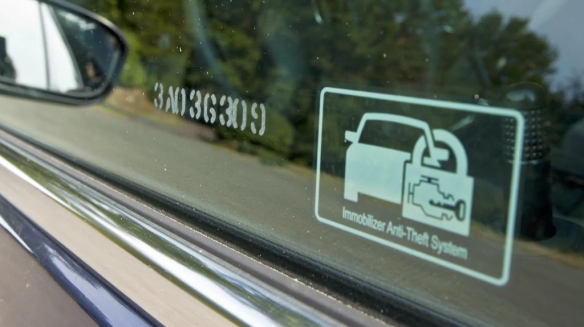
Several weeks after purchasing a pre-owned car, the buyer noticed a charge of $398 that he didn’t recognize. It was labeled as Protection Plus Etch in his sales agreement. He made a quick call to the car dealership and confirmed that he’d been charged for glass etching. Wait, what? “Etching” is a security add-on where a unique code or vehicle identification number (VIN), is etched into the vehicle’s windows.

“The add-on will help identify the car if it was ever stolen and could even lead to discounts on auto-insurance,” the dealer assured him. The gentleman was certain he’d not been told about this service at the time of sale. Worse, when he checked with his insurance company they said that they offered no such discount.

To be clear, etching vehicle windows is not an outright scam, but the practice is of questionable value. There’s a good chance that your insurance company does not offer discounts for window etching on your vehicle, or if they do – that it’s not a substantial amount.

Still think there’s some value in this procedure? Don’t pay a few hundred dollars to the dealership for something that you can do with an $18 kit from Amazon.

If you recently purchased a vehicle, go back and check your sales receipt. Did you unknowingly pay for such a service? The dealer will claim that their etching comes with an insurance policy that will cover a certain amount should your car be stolen and not recovered within a certain amount of time (usually 30 days). Ask to see the details of this policy. If the dealer cannot produce the policy details, demand a refund.

Wondering what else you might have paid too much for? First Financial offers a free review of your deal to see if you are eligible to receive a lower interest rate or lower monthly payment. Some members have saved hundreds, even thousands of dollars in interest by taking a few moments to do this.* Fill out the form below to schedule a free in-person or over-the-phone appointment, to see how much you may be able to save!

Fill out this form to see if we can save you money!

Learn more about First Financial Auto Loans, our Lease Buyout Program, or apply online 24/7.

*APR = Annual Percentage Rate. Not all applicants will qualify, subject to credit approval. Additional terms and conditions may apply. Actual rate may vary based on credit worthiness and term. First Financial FCU maintains the right to not extend credit, after you respond, if we determine you do not meet our guidelines for creditworthiness. A First Financial membership is required to obtain an Auto Loan and is available to anyone who lives, works, worships, volunteers or attends school in Monmouth or Ocean Counties.

Important Alert: Jury Duty Scam

The FBI is warning residents in New Jersey of a phone scam that involves callers impersonating law enforcement officials who demand money, telling the intended victim they failed to appear for jury duty.

According to the FBI’s Philadelphia and Newark divisions, the scammers say they’re with one of several law enforcement agencies, including the U.S. Marshals Service or a county sheriff’s department.

They accuse the call recipient of failing to appear for federal or local jury duty and warn that an arrest warrant has been issued. They tell the intended victim they need to pay a fine through a prepaid debit card, then tell them to provide them with the card information, according to information from the FBI.

“Recent reports indicate these scammers have been targeting New Jersey residents; variations of the ‘jury duty’ scam have been documented in numerous other states, as well,” the FBI said.

The FBI offered the following tips to avoid being victimized by this scam:

  • Never give money or personal information to someone with whom you don’t have ties and did not initiate contact with first.
  • Trust your instincts: if an unknown caller pressures you, or says things that don’t sound right, hang up.
  • If concerns remain about the caller’s claims, verify the information with the appropriate law enforcement agency or court officials.

If you are a victim of a phone or online scam, you should file a complaint with the FBI’s Internet Crime Complaint Center here.

If at anytime you feel any of your First Financial accounts may have been compromised in a similar scam, contact our Member Relationship Center right away at 732.312.1500. If your First Financial credit or debit cards were compromised in a scam, call the 24/7 toll-free number on the back of your card to report the incident and replace your card. All important phone numbers for members can be found on the Contact Us page of our website.

Article Source: Kara Seymour for Patch.com

Scam Alert: Caller ID Spoofing

Scammers are using fake caller ID information to trick you into thinking they’re someone who can be trusted. The practice is called caller ID spoofing, and scammers can basically fake anyone’s phone number and allow you to think they are a representative from a company.

There are even reports that scammers are spoofing the FTC’s Consumer Response Center phone number (877-382-4357). But don’t let that stop you from reporting scammers — it’s still safe to call the FTC Consumer Response Center, and it’s also safe to report scammers online.

If you’ve submitted a report or request to the FTC’s Consumer Response Center, the FTC might call you for additional information. But they won’t call you from 877-382-4357. And the FTC will never ask for money or for sensitive information such as your Social Security Number, date of birth, or bank account information.

Scammers are constantly picking new phone numbers to spoof. Here are a few tips for staying ahead of scammers and their unexpected calls:

  • If you get a strange call from a government phone number, hang up. If you want to check it out, visit the official (.gov) website for contact information.
  • Don’t give out or confirm your personal or financial information to someone who calls.
  • Don’t wire money or send money using a reloadable card. In fact, never pay someone who calls out of the blue, even if the name or number on the caller ID looks legit.
  • Feeling pressured to act immediately? Hang up. That’s a sure sign of a scam.

If you’ve gotten a call from a scammer, with or without fake caller ID information, report it to the FTC.

If at anytime you feel any of your First Financial accounts may have been compromised in a similar scam, contact our Member Relationship Center right away at 732.312.1500. If your First Financial credit or debit cards were compromised in a scam, call the 24/7 toll-free number on the back of your card to report the incident and replace your card. Remember that First Financial will never call and ask you for any sensitive information over the phone. All important phone numbers for members can be found on our website.

Article Source: https://www.consumer.ftc.gov


First Financial Foundation Awards Scholarship to University of Tampa Student

Press Release

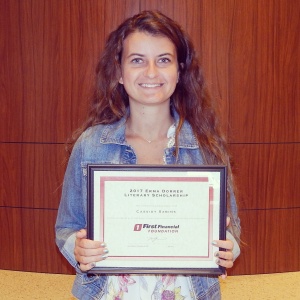
FREEHOLD, N.J. – The First Financial Federal Credit Union Foundation (www.firstffcu.com) awarded a $500 scholarship to Cassidy Sabins of Spring Lake Heights, who graduated from Manasquan High School. She is attending the University of Tampa (Tampa, FL) studying Business Financial Enterprise Systems.

In order to qualify for the scholarship, high school seniors attending school in Monmouth or Ocean Counties were given the option to submit a written essay or create a 60 second video clip. The students must also be attending an accredited 2 or 4 year college or university. Four winners were selected to receive a $500 First Financial Foundation 2017 Erma Dorrer Literary Scholarship.

Essay topic: You and a friend decide that you would like to start building credit. Discuss with your friend what good credit is, ways to start building credit, how your credit union can help, and the benefits earned by having good credit.

Video topic: Create a 60-second video that covers the importance of financial literacy.

Sabins submitted an essay in which she explained that “good credit is taking responsibility for your spending behaviors and only purchasing items that you can afford.” She recommended choosing a credit union, such as First Financial, because it is “a great place to open a savings account” since “member-owned credit unions charge their members lower monthly fees and lower interest on loans as opposed to banks, as well as they support community programs.”

“We are thrilled to be able to aid these admirable and bright young students in their journey of success and education,” said First Financial President and CEO, Issa Stephan. “Our credit union puts a high priority on education. After all, that’s how First Financial began in 1936 – with a group of schoolteachers in Asbury Park.”

# # #

About the First Financial Foundation: Since 1994, First Financial has supported the Monmouth & Ocean communities with the Erma Dorrer Scholarship Program. Today, that program has been extended into the First Financial Foundation to assist charitable organizations of the Monmouth & Ocean County Communities.  The First Financial Federal Credit Union Foundation is a non-profit working to support a variety of community programs and organizations throughout Monmouth and Ocean Counties.  We direct 100% of your contributions to programs because all administrative expenses are paid for by First Financial Federal Credit Union.  To learn more, visit http://www.firstffcu.com.

First Financial Foundation Awards Scholarship to Dartmouth College Student

Press Release

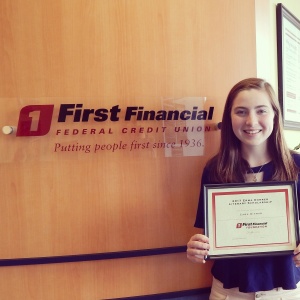
FREEHOLD, N.J.– The First Financial Federal Credit Union Foundation (www.firstffcu.com) awarded a $500 scholarship to Cara Ditmar of Manahawkin, who graduated from Southern Regional High School in Manahawkin. She is attending Dartmouth College’s (Hanover, NH) School of Arts and Sciences.

In order to qualify for the scholarship, high school seniors attending school in Monmouth or Ocean Counties were given the option to submit a written essay or create a 60 second video clip. The students must also be attending an accredited 2 or 4 year college or university. Four winners were selected to receive a $500 First Financial Foundation 2017 Erma Dorrer Literary Scholarship.

Essay topic: You and a friend decide that you would like to start building credit. Discuss with your friend what good credit is, ways to start building credit, how your credit union can help, and the benefits earned by having good credit.

Video topic: Create a 60-second video that covers the importance of financial literacy.

Ditmar submitted a script between herself and a friend, in which she explained that “a credit score represents how financially responsible a person is” and “the better your credit, the more likely it is that companies will be willing to give you loans.” She also mentioned that credit unions, such as First Financial, where she’s had her own student account since 2005, are “great because they’re non-profit, and they are owned by each member of the credit union. They generally have lower interest rates and personalized customer service too.”

“We are thrilled to be able to aid these admirable and bright young students in their journey of success and education,” said First Financial President and CEO, Issa Stephan. “Our credit union puts a high priority on education. After all, that’s how First Financial began in 1936 – with a group of schoolteachers in Asbury Park.”

# # #

About the First Financial Foundation: Since 1994, First Financial has supported the Monmouth & Ocean communities with the Erma Dorrer Scholarship Program. Today, that program has been extended into the First Financial Foundation to assist charitable organizations of the Monmouth & Ocean County Communities.  The First Financial Federal Credit Union Foundation is a non-profit working to support a variety of community programs and organizations throughout Monmouth and Ocean Counties.  We direct 100% of your contributions to programs because all administrative expenses are paid for by First Financial Federal Credit Union.  To learn more, visit http://www.firstffcu.com.