
Kickstart Your Child’s Financial Future: Essential Tips for Parents

There’s no better time than now to start teaching kids about financial responsibility. At First Financial, we are committed to nurturing financial literacy and growth from a young age. Here are some practical tips to help your children develop strong financial habits that will benefit them throughout their lives.

1. Start by Including Them in the Conversation

You may not think to discuss money and finances with your children, but opening up these conversations early can help them grasp the importance of financial literacy and health. Start by teaching them the value of currency by having them earn money through simple tasks. Set savings goals and when they’ve reached a goal, discuss whether to spend the money earned on something they want now or to save it for the future. Pose the discussion around wants and needs and let your kids think through what is more important. This simple practice can instill lasting financial insights and habits. As your children get older, bring new topics into the conversation such as large purchases like cars, bills and expenses, as well as credit card use and debt. The more you discuss with them, the more prepared they will be for the financial realities to come.

2. Open a Savings Account and Encourage Financial Goals

Opening a savings account provides a safe place for your child to store their money, and helps them learn about interest and savings growth from a young age. For a great start, consider our First Step Kids Savings Account designed for Monmouth and Ocean County NJ children up to 18 years old, with no minimum balance requirements or fees and an opening deposit savings match of up to $25.* Once you’ve opened a savings account, set savings goals that can be tied to something your child can look forward to – a new toy, a special outing, or future education costs. Creating a visual savings chart can make this process engaging, and it’s also a good idea to plan monthly check-ins so your kids can watch the money grow in real-time.

3. Teach Budgeting Basics

Introduce the concept of budgeting by helping your child create a simple budget. This could include tracking their allowance, gift money, and any small earnings from chores or part-time jobs. Come up with some small ‘expenses’ so they can understand cash flow, and how to ensure you always have enough money to cover expenses, add to savings accounts, and have some left for miscellaneous spending and emergencies too. As kids reach their teenage years and beyond, our First Financial Student Checking Account for ages 14 to 23 – can facilitate this process with online banking features and electronic statements to make tracking easy.

4. Reward Academic Achievement

Incorporating financial rewards for academic success can motivate children to excel in their studies while learning the value of hard work. Our Dollars for A’s Program rewards Monmouth and Ocean County kids for getting A’s on their report cards, by depositing $1 for each “A” received into their First Step Kids Account.** These rewards keep kids focused on the importance of education and financial growth, while also ensuring their milestones are acknowledged and celebrated.

5. Make Learning Fun

Turn financial education into an engaging activity through contests and challenges. Every summer, our Reader Rewards Summer Reading Contest encourages kids to read books and earn rewards, making learning about finances more enjoyable. From now until the end of August, First Financial kids can earn $1 per book this summer – up to 10 books!+

First Financial is dedicated to fostering financial literacy and independence in young people. Our children and student accounts offer the perfect blend of education, practicality, and fun to help your kids develop strong financial habits. Start their journey to a secure financial future today! For more personalized assistance and tailored solutions call 732.312.1500, visit a branch, or explore our services online.

*Parent or guardian must bring both the child’s birth certificate and social security card when opening a First Step Kids Account at any branch location. Parent or guardian will be a joint owner and must also bring their identification. A First Financial Membership is open to anyone who lives, works, worships or attends school in Monmouth or Ocean Counties. Must open a new First Step account to receive piggy bank, passbook, and to qualify for initial account opening savings match up to $25. The credit union reserves the right to change or cancel this offer at any time. See credit union for details. A $5 deposit in a base savings account is required for credit union membership prior to opening any other account.

**Available for First Financial members between 1st and 12th grades. Child must be present and a deposit to a First Step Kids Account is required to receive the Dollars for A’s incentive. Offer applies only to report cards for most recent school terms. Qualifying report cards must be submitted within 45 days from the date of issue. No back rewards available for prior semesters or marking periods. Letter grade “A” (or school district’s equivalent) or 90%+. Limit of $10 will be rewarded for A’s per each marking period, not to exceed $40 in Dollars for A’s deposited per school year or calendar year.

+First Financial Kids up to age 18 are eligible to participate in our Summer Reading Contest each July and August. Credit Union membership and First Financial Savings Account are required to participate. Participants will earn $1 per book read, up to 10 books. Each book requires a separate entry form to be filled out online using our electronic entry form. Only completely filled out entry forms will be eligible for reader rewards. Participants will earn 1 entry per book read in our prize drawing of three Barnes & Noble® Gift Cards in the amount of $75, $50, and $25. If the parent/guardian prefers – Reader Rewards can be electronically deposited to the child’s First Financial Savings Account when a confirmation email for each book read (up to 10 books), is received and reviewed by the Marketing Department upon completion of a digital entry form. Reader Rewards can also be redeemed in person in any First Financial branch by displaying the confirmation email(s) to a branch employee on a mobile phone or printed out.​ The 3 prize winners will be drawn at random and will be contacted by the First Financial Marketing Department by September 15th.


Tips for Improving Your Financial Literacy

April is Financial Literacy Month, so we’re sharing our top tips for improving your financial wellness. Whether you’re new to managing a budget or are looking to save for a big future purchase, these tips will help you achieve your goals while maintaining a reasonable financial balance.

What is financial literacy?

Financial literacy refers to the knowledge and use of financial management skills, including budgeting, investing, saving, etc. By having an understanding of finances, you’ll be able to make better financial decisions. Achieving financial literacy is a lifelong process that requires continuous learning and management, and we’re here to help!

Here are our best tips for improving your financial literacy.

Learn how to budget

Don’t let the idea of creating a budget scare you. If anything, successfully building and maintaining a budget can be empowering. Start by creating a list of essential expenses including housing costs, food, transportation, clothing, internet, cell phone, insurance, and more. Then, write down how much you spend on each. From there, you’ll need to add up your monthly income and deduct your expenses. The amount leftover should be used toward building your savings and/or for any less essential purchases.

Improve your credit score

Maintaining a good credit score is an important part of your financial future. Without a good score, you’ll have difficulty securing a loan or mortgage down the line. Here’s what you can do over time to better your credit:

  • Pay your bills on time
  • Pay off or pay down your credit cards
  • Don’t close any open credit cards, but slow down opening new credit card accounts
  • Contact a financial expert – like us!

Open a savings account

Whether you need an emergency fund, money for retirement, or to pay a large expense – having a savings account is essential. You can start by dedicating a certain amount of your paycheck toward your savings. While it’s recommended to keep 20% of your income for savings and debt repayment, you’ll need to evaluate what works within your budget and when you’ll need the funds. Even if you’re starting small, you’ll be surprised how quickly the account can grow!

Want to open a savings account?* We’re here for you! Contact us or stop into your local branch to speak with a representative today.

Subscribe to financial newsletters

Stopping at the library and picking up some financial literature might not be everyone’s cup of tea. So, starting with digestible, yet informative articles is ideal. That’s why we recommend subscribing to newsletters (like ours!) with timely resources that cover a wide range of financial topics. The First Financial monthly e-newsletter delivers helpful tools and financial advice right to your inbox, so you can focus on achieving your monetary goals. You can sign up at the bottom of our website homepage, by entering your name and email address.

Talk to a financial professional

If anything, it’s always helpful to speak directly with a financial expert who can give you advice based on your individual situation. Contact us to get started or stop into your local branch to speak with a representative today!


*A $5 deposit in a base savings account is required for credit union membership before opening any other account/loan. All personal memberships are part of the Rewards First program and a $5 per month non-participation fee is charged to the base savings account for memberships not meeting the minimum requirements of the program. Click here to view full Rewards First program details. Some restrictions apply, contact the Credit Union for more information.

Financial Words Parents Should Teach Their Children

Cute little girl is playing with paper money - dollars, isolated over white

Savings: Age 4+
Saving is one of the best topics to introduce at a young age. It’s easy for kids to grasp and can have a huge impact on those who embrace it early. There are plenty of examples parents can use to illustrate, here’s one: Start by giving your child two small pieces of candy during the day. Let them eat one right away and save the other until after dinner. Then each day for a week, give them two pieces but have them save one in a special place. When the week is over, they’ll be excited to have a bag full of candy. Explain that saving money works the same way — when you regularly put a little bit aside, in time it will add up to something big.

Budget: Age 8
A budget is plan that you make to keep track of your money and where it is going. One great way that a lot of parents teach kids how to budget is with “give, save, spend jars.” Whenever the child earns money they divide it between the jars. The “save” jar is money that’s intended for a longer-term goal; money in the “spend” jar can be used any time for smaller purchases; the “give” jar is money that will go to a charity of their choosing. The give jar, in particular, is great for getting kids to think about helping others while allowing them the freedom to choose where to donate their money.

Loan: Age 8
A loan is something that is borrowed, often money, which has to be paid back with interest. Most kids get the basic concept of a loan because chances are, at one time or another, they’ve lent something to a friend or sibling and expected to get it back.

Start by explaining some of the reasons people take out loans. For instance, because it costs a lot of money to buy a house most people borrow money (take out a mortgage) to pay for it. Even kids know that $300,000 is a lot of money, so when they hear that’s the average price of a house they can understand why most people borrow money to cover it. Car loans and student loans are also good ones to discuss.

While taking out a loan isn’t a bad thing, parents need to stress that when you do take on a loan, it’s your responsibility to pay it back.

Debt: Age 8
Loans and debt can be explained together. Like a loan, a debt is money that you owe someone that needs to be paid back. Once again, a mortgage can be a good way to illustrate how debt works.

Interest: Age 8-10
Interest has two sides: it’s either something you pay when someone lends you money or something that you earn when you lend money to someone else. You could explain interest to your child by telling them they could earn interest if, for example, “your sister runs out of her allowance but needs money this weekend. You could lend her $20 but charge her $2 in interest, which she will have to pay you back next week.”  You can also make it into a game to illustrate how it works: Ask to borrow a few dollars from your child’s piggy bank and then set up a schedule to pay it back over the next month with interest.

Explain to older kids how you pay a financial institution interest on a car loan or mortgage each month. Also point out that the financial institution pays interest on deposits you keep in your accounts there.

When kids are older and can calculate simple percentages, have them do some math to see how interest adds up. Show them a credit card agreement that charges 15% interest and have them figure out how much extra money you would have to pay to carry a balance of $5,000 or $10,000 on your credit card, versus if you paid it off right away.

Credit Card: Age 8-10
Credit lets you buy something without having to pay for it right away. For example, if you use a credit card to buy a new bike that costs $200, the money doesn’t come out of your bank account. Instead the credit card company pays for the bike. Then they send you a bill and you have to pay them back the $200. If you don’t pay them back right away, they will charge you extra money (interest).  The longer it takes you to pay back, the more money you will owe in the end. While credit cards are necessary to have — kids need to understand that they should only be used to buy things that they can afford to pay off right away.

Parents should also explain how a debit card is different as it takes money directly from your checking account. When you’re at the store and you slide the debit card, explain that the card is taking the money right out of your account at that very moment.

Taxes: Age 10-12
Chances are most kids know the word but few understand what taxes are. Here’s the explanation: Taxes are payments that go to the government for the work that it does, such as improving schools and fixing roads. They’re taken right from your paycheck and the amount you pay depends on how much money you make.

You can also explain to older kids that doing certain things, which have a positive impact such as donating money to charity or installing solar panels on your house, can lower your taxes.

Investment: Age 10-12
An investment is something that you spend money on, which you believe will earn you even more money (a profit) down the line. Kids should know, however, that although people invest in things that they hope will make them more money, it doesn’t always happen that way. That’s why it’s never a good idea to put all of your money in a risky investment, because if you do and the investment fails, you could loose it all.

Stock: Age 12+
A stock is a piece of a company. When you own stock in a company, you own a small piece of its business. Every stock has a price and that price can go up or down, depending on what’s happening at the company.

Stock movements are best illustrated to kids with an example of a company they know. For instance, say you bought one share of Apple AAPL -0.16% stock for $5 . If the company sold a ton of iPhones, which is good for the company, it could make the stock price go up to $8, meaning you would have earned $3 on your investment. On the other hand, if Apple didn’t sell a lot of iPhones and the stock fell to $2, you would have lost $3. Most people don’t own a single piece of a stock (a share) – but tens, hundreds or thousands of shares. And most people also own stock in several different companies. The “stock market” is where people buy and sell (trade) their stocks. There is an actual place where stocks are traded but it can also be done over the Internet.

Learning about stocks can be particularly fun as kids get older. There are a lot of online games and apps they can use to create virtual stock portfolios, which can show them how stock prices move and how much money they would have made or lost if they been dealing with real money.

401(K): 14+
As kids enter the teenage years, it’s a good time to begin preparing them for some of the things they will likely encounter once they enter the workforce, one of which is a 401(k) plan. A 401(k) is a savings account for retirement offered by your employer. The money that you put into a 401(k) is taken out directly from your paycheck, and is intended solely for retirement. You can’t withdraw it until age 59½.

The money that’s put into a 401(k) gets put into different investments. The ideas is that the investments will increase over time, so the money in the 401(k) will grow as well.

Credit Score: Age 15+
Once you plan to give your child use of a credit card, you must explain what a credit score is. Here’s how to explain it: There are three credit bureaus, which calculate your “credit score” or how you use your money. The goal is to have a high credit score. The way to receive a high score  is to have a long history of paying your bills on time. When you don’t pay your bills on time or you have too much debt, your score gets lowered.

It’s important to emphasize that a good credit score will help in the future if you want to borrow money to buy a house or a car. Meanwhile a bad credit score can make it difficult for you to borrow money.

Jackson Memorial Students Get Taste of Financial Reality

Tri-Town News article by Andrew Martins:

DSCN0228Financial independence can be a scary thing for young adults who are beginning to make their own way in life after graduating from high school or college. Unexpected costs arise, debt can become bloated, and temptations to spend frivolously crop up every day.

For a group of freshmen at Jackson Memorial High School, the sobering reality of money and adulthood was put on display during an event dubbed the Financial Reality Fair.

“The goal of the fair is to teach the kids the value of money and how to manage their money when they leave high school,” said Issa Stephan, First Financial Federal Credit Union president and CEO. “It is very crucial these days to be financially savvy, and there is a lot of temptation out there.”

Financial responsibility is a subject that Stephan believes should have a bigger focus in public schools. He cited the economic downturn that began in 2008 as a prime example for why such responsibility is imperative for the future.

“I think that since 2008, people are more conscious about money,” he said.

On Jan. 8, students tackled financial issues in a hands-on manner without potentially destroying their credit rating.

“These days, it is easy to get in trouble,” Stephan said. “Twenty years ago, you had to drive to the mall and take your cash to spend it. Now you can be sitting in your bed, clicking yourself away into financial trouble” on a computer.

The idea for the fair, according to First Financial Marketing Manager Jessica Revoir, was based on similar events held throughout the state by the New Jersey Credit Union League Foundation, which sponsored the Jackson Memorial High School event.

DSCN0230Students were initially instructed to choose a career. After each student selected a job, that career’s starting salary after taxes was used as the baseline for a monthly budget. The young adults were informed that some expenses were required, including food, clothes and rent; and some expenses were not required, including gym memberships and vacations.
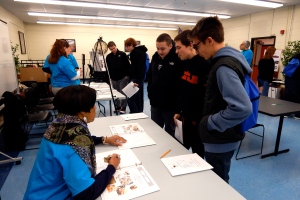
Stephan said the point was to illustrate the importance of determining what is needed and what is not needed.

“If you move out [of your parents’ home], you have to pay rent and insurance, but people usually get in trouble with what I call ‘variable expenses,’ ” he said. “A lot of people see a smartphone as a fixed cost … but it is not. There are ways to make even a necessity much more affordable in the long run. If you shield the students from reality, they fall.”

Stephan said students were led astray on purpose as a means of letting them see the difference between what they want and what they need.

At the transportation booth, for example, a binder was purposely left open at a page featuring luxury cars and sports cars for purchase, rather than being left open at a page with less expensive vehicles or public transportation.

“We are trying to teach these kids that if they let themselves be manipulated financially when they get older, they can get into some serious trouble,” First Financial Investment and Retirement Center Coordinator Samantha Schertz said.

To Lisa Scott, who teaches honors economics and financial literacy, the fair provided an opportunity for her students to take a more tactile approach to learning the importance of finances.

“This really is experiential learning for our kids because, to them, the class is just the textbook and something they need to graduate, but then they come here and realize they need this to live and get through adulthood,” Scott said.

The fair was a sobering realization that made freshman Claudia Besse take a moment to consider her future.

“I learned that I am very grateful for my parents, for one,” Claudia said. “I never realized that your gross pay is not your take-home pay and that there are so many expenses. Cars are so expensive.”

Scott said those realizations are fueled not only because of the way that financial education is traditionally handled in school, but also because some parents provide everything for their children.

DSCN0223“What I am hearing as the kids go through the fair is they ask, ‘Does that cost that?’ A lot of kids don’t have to pay for the things they enjoy right now … so for some kids, this is a revelation,” Scott said.

Stephan said he and his staff hope the students will take what they learned at the event and apply it to their lives.

“I saw some kids calculating and trying to make smart decisions, and I saw others just not caring as much. And that, in a way, reflects society,” he said. “We need to try to catch people before they get into financial trouble.”

Jackson Memorial High School Students Get Schooled in Money Management

Asbury Park Press Article by Amanda Ogelsby:

Screen shot 2014-01-22 at 1.25.08 PM

How do you teach teens how much it really costs to live?

JACKSON, NJ — Fourteen-year-old Aylin Torenli of Jackson spent a recent Wednesday morning calculating whether the salary of a dental hygienist would be enough to afford her the finer things of life: a smart phone, upscale furniture, television.

“I didn’t realize how expensive it was,” Torenli said of life’s luxuries that quickly add up. The freshman joined more than 200 Jackson Memorial High School students at a Financial Reality Fair Wednesday that was designed to give teenagers the foundations for a lifetime of successful money management.

After picking a “career” and its related income, students visited various stations where they chose cellphone plans and car payments, looked at housing costs, and calculated quality-of-life expenses like dining out and spa treatments.

“You understand how hard it is to be in the financial world,” Torenli said after meeting with a financial adviser to review her budget. “I give a lot of credit to my parents now.”

Under New Jersey law, public school students must learn about money management, insurance, saving and investing, as well as credit and debt management, beginning by fourth grade.

Public high school students are required by state law to take 2.5 credits of financial literacy and economics to graduate, according to the state Department of Education. That law went into effect in the 2010-11 school year, beginning with then ninth-graders.

The 2008 recession — when financial markets around the world fell following a collapse of the U.S. housing market — triggered the need for such educational programs, said Issa E. Stephan, president of First Financial in Wall, which helped to organize the event along with the New Jersey Credit League Foundation.

“Our mission for the fair is to help the students understand the value of money and how to manage their money, so as they grow as an adult, they’ll be more financially responsible,” Stephan said.

In a country loaded with easy temptations to spend, financial literacy is crucial, he said.

At the spinning “Reality Wheel,” students took a risk at budget breakers like car repairs and accidents.

“We just want to give them a little wake-up call,” said Janice Anderson of First Financial, who talked to students about managing monthly food budgets.

Freshman Tom Del Monte, 15, said the Financial Fair helped him better understand the importance of securing a good job after high school. The Jackson freshman said he was shocked by the high prices of cellphones and food.

“I finally understand the reality of what we’re learning in class,” he said. “I didn’t realize what my parents pay.”

“We hope this (fair) leads to better consumers,” said Lisa Scott, a business, finance and economics teacher at Jackson Memorial High School.

She added: “They’re coming face-to-face with the reality of whether or not that (job) will buy them all the things that they think they’re going to have when they are young adults out on their own for the first time. It is a rude awakening for some of them.”