Jackson Memorial Students Get Taste of Financial Reality

Tri-Town News article by Andrew Martins:

DSCN0228Financial independence can be a scary thing for young adults who are beginning to make their own way in life after graduating from high school or college. Unexpected costs arise, debt can become bloated, and temptations to spend frivolously crop up every day.

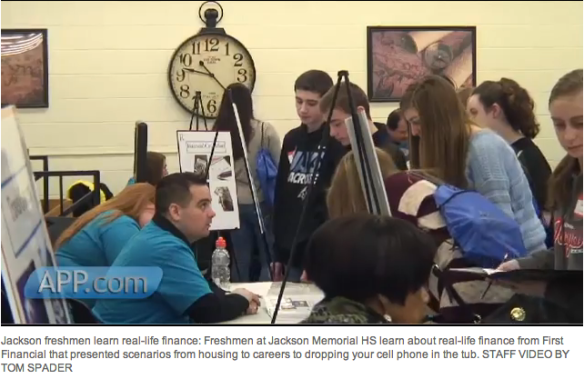
For a group of freshmen at Jackson Memorial High School, the sobering reality of money and adulthood was put on display during an event dubbed the Financial Reality Fair.

“The goal of the fair is to teach the kids the value of money and how to manage their money when they leave high school,” said Issa Stephan, First Financial Federal Credit Union president and CEO. “It is very crucial these days to be financially savvy, and there is a lot of temptation out there.”

Financial responsibility is a subject that Stephan believes should have a bigger focus in public schools. He cited the economic downturn that began in 2008 as a prime example for why such responsibility is imperative for the future.

“I think that since 2008, people are more conscious about money,” he said.

On Jan. 8, students tackled financial issues in a hands-on manner without potentially destroying their credit rating.

“These days, it is easy to get in trouble,” Stephan said. “Twenty years ago, you had to drive to the mall and take your cash to spend it. Now you can be sitting in your bed, clicking yourself away into financial trouble” on a computer.

The idea for the fair, according to First Financial Marketing Manager Jessica Revoir, was based on similar events held throughout the state by the New Jersey Credit Union League Foundation, which sponsored the Jackson Memorial High School event.

DSCN0230Students were initially instructed to choose a career. After each student selected a job, that career’s starting salary after taxes was used as the baseline for a monthly budget. The young adults were informed that some expenses were required, including food, clothes and rent; and some expenses were not required, including gym memberships and vacations.

Stephan said the point was to illustrate the importance of determining what is needed and what is not needed.

“If you move out [of your parents’ home], you have to pay rent and insurance, but people usually get in trouble with what I call ‘variable expenses,’ ” he said. “A lot of people see a smartphone as a fixed cost … but it is not. There are ways to make even a necessity much more affordable in the long run. If you shield the students from reality, they fall.”

Stephan said students were led astray on purpose as a means of letting them see the difference between what they want and what they need.

At the transportation booth, for example, a binder was purposely left open at a page featuring luxury cars and sports cars for purchase, rather than being left open at a page with less expensive vehicles or public transportation.

“We are trying to teach these kids that if they let themselves be manipulated financially when they get older, they can get into some serious trouble,” First Financial Investment and Retirement Center Coordinator Samantha Schertz said.

To Lisa Scott, who teaches honors economics and financial literacy, the fair provided an opportunity for her students to take a more tactile approach to learning the importance of finances.

“This really is experiential learning for our kids because, to them, the class is just the textbook and something they need to graduate, but then they come here and realize they need this to live and get through adulthood,” Scott said.

The fair was a sobering realization that made freshman Claudia Besse take a moment to consider her future.

“I learned that I am very grateful for my parents, for one,” Claudia said. “I never realized that your gross pay is not your take-home pay and that there are so many expenses. Cars are so expensive.”

Scott said those realizations are fueled not only because of the way that financial education is traditionally handled in school, but also because some parents provide everything for their children.
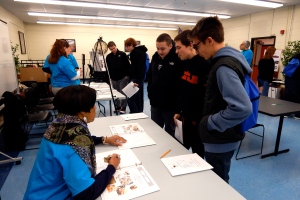
DSCN0223“What I am hearing as the kids go through the fair is they ask, ‘Does that cost that?’ A lot of kids don’t have to pay for the things they enjoy right now … so for some kids, this is a revelation,” Scott said.

Stephan said he and his staff hope the students will take what they learned at the event and apply it to their lives.

“I saw some kids calculating and trying to make smart decisions, and I saw others just not caring as much. And that, in a way, reflects society,” he said. “We need to try to catch people before they get into financial trouble.”

Jackson Memorial High School Students Get Schooled in Money Management

Asbury Park Press Article by Amanda Ogelsby:

Screen shot 2014-01-22 at 1.25.08 PM

How do you teach teens how much it really costs to live?

JACKSON, NJ — Fourteen-year-old Aylin Torenli of Jackson spent a recent Wednesday morning calculating whether the salary of a dental hygienist would be enough to afford her the finer things of life: a smart phone, upscale furniture, television.

“I didn’t realize how expensive it was,” Torenli said of life’s luxuries that quickly add up. The freshman joined more than 200 Jackson Memorial High School students at a Financial Reality Fair Wednesday that was designed to give teenagers the foundations for a lifetime of successful money management.

After picking a “career” and its related income, students visited various stations where they chose cellphone plans and car payments, looked at housing costs, and calculated quality-of-life expenses like dining out and spa treatments.

“You understand how hard it is to be in the financial world,” Torenli said after meeting with a financial adviser to review her budget. “I give a lot of credit to my parents now.”

Under New Jersey law, public school students must learn about money management, insurance, saving and investing, as well as credit and debt management, beginning by fourth grade.

Public high school students are required by state law to take 2.5 credits of financial literacy and economics to graduate, according to the state Department of Education. That law went into effect in the 2010-11 school year, beginning with then ninth-graders.

The 2008 recession — when financial markets around the world fell following a collapse of the U.S. housing market — triggered the need for such educational programs, said Issa E. Stephan, president of First Financial in Wall, which helped to organize the event along with the New Jersey Credit League Foundation.

“Our mission for the fair is to help the students understand the value of money and how to manage their money, so as they grow as an adult, they’ll be more financially responsible,” Stephan said.

In a country loaded with easy temptations to spend, financial literacy is crucial, he said.

At the spinning “Reality Wheel,” students took a risk at budget breakers like car repairs and accidents.

“We just want to give them a little wake-up call,” said Janice Anderson of First Financial, who talked to students about managing monthly food budgets.

Freshman Tom Del Monte, 15, said the Financial Fair helped him better understand the importance of securing a good job after high school. The Jackson freshman said he was shocked by the high prices of cellphones and food.

“I finally understand the reality of what we’re learning in class,” he said. “I didn’t realize what my parents pay.”

“We hope this (fair) leads to better consumers,” said Lisa Scott, a business, finance and economics teacher at Jackson Memorial High School.

She added: “They’re coming face-to-face with the reality of whether or not that (job) will buy them all the things that they think they’re going to have when they are young adults out on their own for the first time. It is a rude awakening for some of them.”

5 Costly Home Buying Myths

Moving HouseIf you’re considering buying or selling a home, you may have asked co-workers, friends and family for advice. But you might want to check with the professionals, because the rules of the real estate game are different today than they were 20 or even 10 years ago. Due to this monumental shift, there are lots of misconceptions about buying a home that could cost you big when it comes time to go house hunting. Here are five of the most common real estate myths.

1. You Have to Use a Real Estate Agent. If you’re thinking about buying or selling a house without a real estate agent to save on commission, it’s important to understand the full impact of that decision. Buying and selling is a lot of work and there’s a reason real estate agents still exist and are involved in almost all transactions. For most of us, the sale of a house represents one of the biggest financial transactions we’ll ever make.

It’s nice to have someone there guiding you along the way. But while having an agent can be a good thing, doing it on your own is not as unimaginable as it once was. Sites like Redfin and Zillow have virtually eliminated the need for the multiple listing service and many homebuyers are finding properties for themselves before contacting a real estate agent. If you’re the do-it-yourself type, you might just be able to buy or sell a home on your own in today’s market.

2. Buying Always Beats Renting. One reason people give for not wanting to rent is: “I don’t want to pay someone else’s mortgage.” However, there are hidden costs that go into owning a home. The nice thing about renting is that you can always leave for a nicer place for a year or two. Or maybe you lose your job and need to downgrade for a few months before you get on your feet again. Once you buy a house, there’s a lot less flexibility. Just the fees involved in buying and selling a house will make a major dent into your savings if you sell too soon after buying.

3. This House Is Special. Once you’ve finally found that perfect house, the inclination is to think you won’t find another that you like nearly as much. There will always be another property. If something doesn’t feel right or the price is too high, don’t be afraid to wait for the next one. As long as you have realistic goals, no house will ever be truly one of a kind.

4. Your Credit Must Be Perfect. With the recent housing bubble, came a wave of lending restrictions and loan tightening. Most people assume that they have to have stellar credit to get a loan these days, but that’s not always the case. Lenders are often willing to work with buyers who have less-than-perfect credit. If you’re concerned about your credit, you may want to work on your credit score before you buy; people with higher credit scores are offered the lowest interest rates on mortgages.

5. A 20% Down Payment is a Must. Twenty percent used to be the magic number when it came to down payments, but it’s certainly not the only option. It’s possible to get a mortgage now with little or no money down. If you have a stable income but are unwilling or unable to fund a large down payment, you may still be able to buy a home.

Apply for a 10, 15, 20, or 30 year First Financial Mortgage today!You can also subscribe to our Mortgage rate text message service by signing up for text alerts, and receive instant notification when our mortgage rates change.***

* A First Financial membership is required to obtain a mortgage and is open to anyone who lives, works, worships, or attends school in Monmouth or Ocean Counties.  Subject to credit approval. See Credit Union for details.

Note: You must check the Text Message Signup box when registering in order to receive rate change text messages.+ If you do not receive an automated confirmation message after enrolling, please text “Yes” to (201) 808-1038

+The Text Message Signup box must be checked in order to receive text messages. Standard text messaging and data rates may apply.

Article Source: http://www.foxbusiness.com/personal-finance/2013/12/19/5-costly-homebuying-myths/

equal%20housing%20lender%20logo-resized-600

The Basics: Student Checking

Students with laptop computerMany young adults enter the “real world” lacking the proper knowledge in financial literacy. The following information will assist with setting up and understanding the features and benefits of student checking accounts more clearly.

What Can a Checking Account do for You?

A checking account offers easy accessibility to your money anytime, anywhere and it also helps keep your cash secure – often times through use of a debit card. A debit card is a card that grants you electronic access to the money in your account, which is often referred to as a check card. You may also receive checks to make purchases or pay bills from your checking account. This makes it easier to spend and receive money without carrying cash. Checking accounts are also important for building credit, which you will need to make major purchases such as a car or a house in the future.

A great checking account option for students is Student Checking. The perks of Student Checking accounts vary among financial institutions, but many include free checks, free ATM usage, and better loan rates.

Preparation

Before opening a checking account, make sure you are prepared. Here are a few tips to remember when you begin the process:

  • Get all of your personal documents together. You will have to prove that you are who you say you are, to open an account. Make sure you have the proper identification such as a driver’s license, photo I.D. card, and Social Security card.
  • Know what services your credit union or financial institution offers. Does the institution provide online banking and bill pay? What fees (if any) does the account charge?
  • Look for branch and ATM locations. When choosing a financial institution, it’s a good idea to check for locations near your home, job, or school. It’s also a good idea to consider the locations and availability of their ATMs.
  • Be able to identify fraud. Many Americans have been exposed to financial scams as of late, and even more are unable to identify classic red flags. Common fraud attempts include propositions for “educational” investment meetings, or being offered money in exchange for paying a fee or making an initial deposit. Use common sense and be cautious around offers that seem too good to be true.

First Financial offers Student Checking to students who live, work, worship, or attend school in Monmouth or Ocean County, ages 14-23.*

The account includes the following features and benefits:

  • A free first box of checks and an allowance of the first mistake being free+
  • Free phone transfers to the account by parents
  • No per-check charges
  • No minimum balance requirements
  • No monthly service charge for having the account
  • A Debit Card issued instantly in one of our Monmouth or Ocean County      branches.
  • Free Online Banking with Bill Pay
  • Unlimited in-branch transactions

Remember that it is important to establish yourself financially as a student. After your schooling is finished, you will begin your search for a career. Understanding your account and personal finance can only help you when you begin this independent stage of life, and First Financial is here to help you every step of the way!

*A $5 deposit in a base savings account is required for credit union membership prior to opening any other account. All personal memberships are part of the Rewards First program and a $5 per month non-participation fee is charged to the base savings account for memberships not meeting the minimum requirements of the program. Click here to view full Rewards First program details. Accounts for children age 13 and under are excluded from this program.

+ Call or visit a branch to request refund of the first fee incurred. We must receive request within 90 days of date fee is charged in order to be eligible for refund. The eligible fees are NSF, Overdraft, and Courtesy Pay fees.

What’s the Worst Kind of Debt?

DEBT inscription bright green lettersWhat is the worst kind of debt to carry? Is it student loan debt, credit cards, a mortgage — or something else? Even the experts don’t always agree on which debt is “good debt” and which is “bad,” so imagine how confusing it can be to consumers who are dealing with debt!

Student Loan Debt

Why student loan debt is the worst: The loans are often given to young people with no credit experience and no clue how they will pay them back. Balances are often high, and the jobs borrowers counted on to make payments may be non-existent or take a really long time to acquire. Finally, unlike every other type of consumer debt, it is very difficult to discharge balances in bankruptcy.

And why it may not be: College graduates, on average, still earn significantly more over their lifetime than those without a college degree. In that sense, student loan debt can be considered an investment that pays off in future earning power. In addition, students may be able to defer payments on their student loans during times of economic hardship (usually at a cost), which makes them more flexible than other types of loans. In addition, borrowers may be eligible for reduced payments and loan forgiveness under the Income-Based Repayment Program or other loan forgiveness programs.

How does student debt affect credit scores? Large balances typically don’t hurt credit scores as long as the payments are made on time.

Credit Card Debt

Why credit card debt is the worst: With interest rates hovering around 15 percent on average — and more than 20 percent for some borrowers — credit card debt is often the most expensive kind of debt consumers carry. And with the low minimum monthly payments that issuers offer, cardholders can find themselves in debt for decades if they aren’t careful.

And why it may not be: While making minimum payments on credit cards is not a great idea over the long run, having that option can come in handy in a financial pinch. It can give cardholders time to get back on their feet without ruining their credit.

As far as credit scores are concerned, as long as cardholders keep balances low (usually below 10 to 20 percent of their available credit), and make minimum payments on time, credit card debt should not hurt credit scores.

Mortgage Debt

Why mortgage debt is the worst: If you wonder how bad mortgage debt can be, just ask the owners of some $8.8 million homes that CoreLogic said had negative or near-negative equity as of the second quarter of 2013. That means those owners owe close to, or more than, what the property is worth. That also means they can’t sell those houses without shelling out money to pay off their mortgage or doing a short sale that damages their credit scores. Even for those who aren’t under water, rising taxes and/or insurance premiums, the cost of maintenance and loans that typically take 30 years to pay off can make one’s home feel like a financial prison at times.

And why it may not be: Over time, homeownership remains one of the key ways average Americans build wealth. If you are able to keep up with your home loan payments, eventually the home will be paid off and provide inexpensive housing or rental income. Equity that has built up can be accessed through a reverse mortgage or by selling the house, or it can be passed along to heirs — sometimes tax-free.

When it comes to credit scores, this type of loan will generally help, as long as payments are made on time. Even large mortgages shouldn’t depress credit scores, unless there are multiple mortgages with balances. That’s usually a problem that affects real estate investors however, not homeowners with one or two homes.

Tax Debt

Why tax debt is the worst: If you owe the Internal Revenue Service or your state taxing authority for taxes you can’t pay, you can suffer a variety of painful consequences. If a tax lien is filed, your credit scores will likely plummet. In addition, these government agencies usually have strong collection powers, including the ability to seize money in bank accounts or other property, or to intercept future tax refunds.

And why it may not be: The IRS offers repayment options that may allow a tax debt to be paid off over time at a fairly low rate. (Similar programs are available for state tax debt in many states). And unlike applying for a loan, you don’t have to have good credit to get approved for an installment agreement.

The good news when it comes to credit scores is that tax debt itself isn’t reported to credit reporting agencies; a tax lien is the only way that it may show up. By entering into an installment agreement, you may be able to get a tax lien removed from your credit reports, even before you’ve paid off what you owe.

Auto Loan Debt

Why auto debt is the worst: The average auto loan now lasts five and a half years, and some 12 percent last six to seven years, according to Edmunds.com. That means payments will last long after that new car smell has worn off and well into the years when maintenance and repair costs start creeping up. Even more troubling, these borrowers may be stuck if they need to sell their vehicles since they may be “upside down,” owing more than what they can sell their car or truck for.

And why it may not be: Many consumers budget for a car payment, and as long as they aren’t hit with unexpected expenses, they are able to make this payment a priority. In addition, borrowers may be able to refinance their auto loans and lower their monthly payments. Plus, cars often get people to work, where they can earn the money they need to pay off debt.

Vehicle loans that are paid on time can help credit scores, and are rarely a problem unless someone has several car loans outstanding at once or misses a payment.

The Worst Kind Of Debt

When it comes down to it, the worst type of debt is … (drumroll please), the one you can’t pay back on time. If that happens, your credit scores will suffer, your balances may grow larger due to fees and interest, and you may find yourself borrowing even more as you try to keep up with your payments.

Article Source: http://www.huffingtonpost.com/creditcom/whats-the-worst-kind-of-d_b_4220046.html 

52 Week Savings Challenge

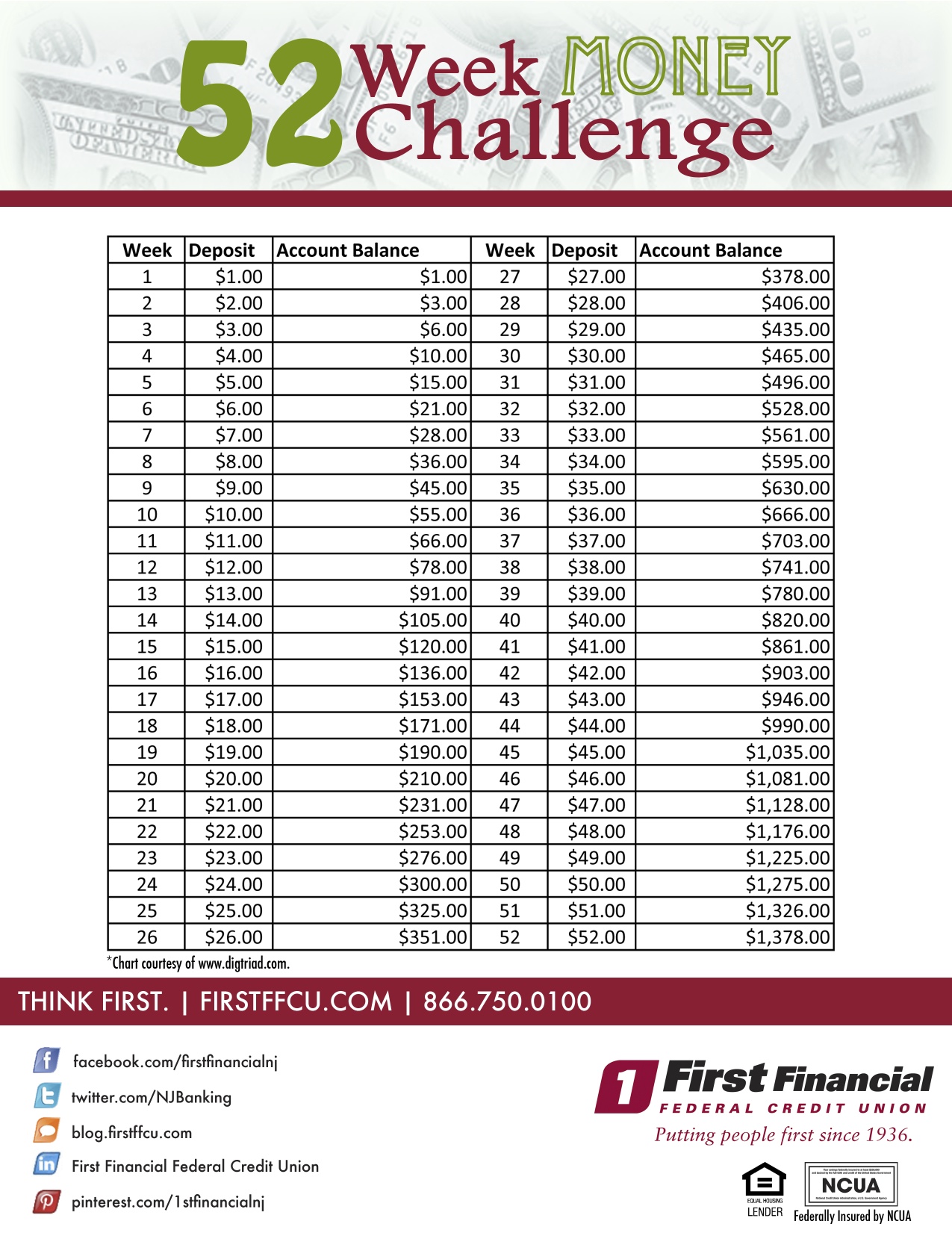
Start your new year off the right way – by saving money.  Take the 52 week money challenge below, and you’re guaranteed to save almost $1,400 by the start of the new year. Ready, set, go!

52WeekMoneyChallenge JPEG