
4 Ways to Avoid Cybercrime When Banking and Shopping on Your Smartphone or Tablet

business man hand use mobile phone streaming virtual business network process diagram

The nature of identity fraud is changing. With the rollout of smart chips in credit and debit cards making it more difficult to steal using cards themselves, thieves have their eyes on your data instead.

If you don’t protect yourself, you could join the millions of Americans who reported they got hit by identity thieves.

While mobile banking and payments are certainly making it easier and more convenient to handle one’s finances and conduct business, the same ease and convenience make them a ripe target for criminals, says Madeline Aufseeser, CEO of fraud prevention company Tender Armor.

“Because merchants are trying to make it easier for consumers to shop online and on their phones, all your credentials are stored online, including payment information, and you don’t even need a basket — just click a button and boom, you get charged. Because they have gone down this path of making things easier to purchase online, it makes it easier for the fraudsters to get to the data,” said Aufseeser.

Consumers are turning to their phones more often to manage their finances, from depositing funds to paying bills to splitting dinner and a movie among friends. Mobile payment apps are growing in popularity, particularly among Millennials.  A survey by FICO found that 32% of consumers 18 to 34 had used some kind of mobile payment app, and 23% had used a peer-to-peer lending app.  According to consulting firm Accenture, 94% of consumers under 35 access their banking services through the Web and mobile apps.

Don’t be a victim!  Here are 4 ways to protect yourself and your finances:

Safety tip # 1: Update your OS

People who are not careful about how they use their mobile payment apps, where they use them and how they manage their mobile devices, are putting themselves at risk. For starters, avid users of mobile payment services should always keep their mobile operating system, or OS, up to date. Ignoring updates for Android or iOS means ignoring free security patches for vulnerabilities hackers already know how to exploit.

Safety tip # 2: Update that app

The same goes for the apps themselves — keeping a payment app completely up to date means keeping its security protocols as strong as they can be. Some apps introduce new security features, like biometric sign-in capabilities. Aufseeser stresses the importance of two-factor authentication for passwords and personal information to double down on account protection.

Safety tip # 3: Beware of Wi-Fi

Accessing a mobile banking app or a payment app while on public Wi-Fi also makes it easier for criminals to “eavesdrop” on the information one’s phone is sending and accessing, exposing usernames, passwords and any stored information on the phone — including saved credit or debit card info from payment apps. Consumers with data to spare should limit their use of public Wi-Fi hotspots when accessing sensitive information, checking a bank statement, sending a payment, etc. Keep in mind, fraudsters and hackers can eavesdrop on any information sent over public Wi-Fi, so mind your browsing and emailing in public spaces.

Safety tip #4: Watch out for person-to-person payments

Besides guarding yourself from hackers, you have to be on guard about the people you do business with as well. The wild west of mobile payments has tangible, real-world fraud risks associated with it. The incredibly popular person-to-person payment app Venmo, has exposed some of the weaknesses in the mobile payment ecosystem.

While users expect their payments to be safe and instantaneous, the reality is more complicated. Payments take time to process, which leaves a period of time during which scam artists can abuse a clause in Venmo’s user agreement that prohibits “business, commercial, or merchant transactions.” The buyer cancels their payment and the seller cannot get the money back because, technically, they broke Venmo’s rules. In short: If you sell something to someone and they take back their payment, you’re out of luck.

This phenomenon is not unique to Venmo — various frauds and scams have plagued person-to-person payment sites and apps since the dawn of the Internet. Fraudsters populate websites like Craigslist and Ebay and use PayPal scams to rip off unsuspecting users, like having a seller send their item to a different address than is listed on the buyer’s PayPal account, effectively voiding any protections from PayPal and allowing the scammer to recall their payment and keep the item. However, as the Consumer Federation of America noted, there is no federal law that provides payment dispute rights.

Without laws in place, it falls to the company that owns the payment platform to resolve disputes — and when it comes to cybercriminals and fraudsters, they are pretty good at covering their tracks and leaving their victims high and dry. The moral of the story is – be mindful when sending payments with your mobile phone or tablet.

Article Source: 

http://www.usatoday.com/story/money/personalfinance/2016/04/20/security-identity-theft-cybercrime-banking-shopping-mobile-phones/82466908/ by Benjamin Mitchell

Press Release: New Corporate Office is Open!

Press Release

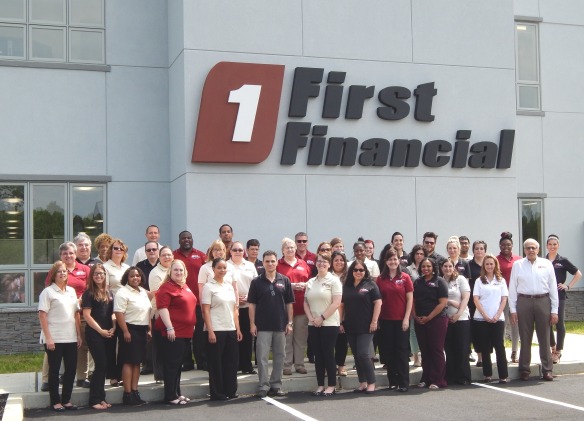
2016 New Corporate Office Opening - June Staff Photo

Pictured above: First Financial staff in front of their new corporate office that is now open!

First Financial Federal Credit Union’s new corporate office is now open (www.firstffcu.com) and located at 391 Route 9 North (next to the Howell Park & Ride) in Freehold, NJ 07728.

The credit union’s new corporate office is located on the same property as their newest branch which opened in early 2015, the Freehold/Howell Service Center (389 Route 9 North).  This branch now serves about one third of the credit union’s nearly 19,000 members.

This new corporate office boasts two stories, spans 20,000 square feet, and has the same modern design as First Financial’s newest branch directly in front of it.

In regard to the credit union’s new corporate location, Issa Stephan, First Financial’s President/CEO stated, “We are dedicated to Monmouth and Ocean county residents and businesses, and we were fortunate enough to be able to buy this land on a main highway like Route 9 and build our new corporate offices. The new building will provide enhanced operational efficiencies that will help us to grow and evolve to keep pace with our members’ needs.  The corporate location represents our commitment to our members and our investment in Monmouth and Ocean counties to deliver a member-centric approach to banking.  This is a win-win-win for New Jersey, for our First Financial employees, and for our members.”

###

About First Financial Federal Credit Union:

First Financial Federal Credit Union (formerly Mon-Oc Federal Credit Union) is a not-for-profit financial cooperative whose goal is to provide the highest level of quality products and personalized services while maintaining financial integrity and stability.  Our vision is to be a long-term financial partner with our Members. While First Financial has a highly trained, professional staff using the latest technology, we also pride ourselves on our personal touch. Unlike huge banking conglomerates, policy setting and overall strategic direction of First Financial are overseen by a volunteer Board of Directors made up of credit union members. The credit union is federally insured by the NCUA. For more information on First Financial, visit www.firstffcu.com.

9 Hacks for a Perfect Monthly Budget

Pencil on the statement of payroll details

While the word “budget” may want to send some of us screaming in the other direction, creating a successful budget is actually one of the biggest gifts we can give ourselves. It not only helps you out financially, but it does a ton to reduce the day-to-day anxiety so many of us feel when it comes to our finances.

If you’re losing sleep over your monthly finances but don’t know where to begin, here are eleven helpful tips for getting started with a monthly budget.

Grab Your Calculator and Block Out Some Time

Grab your calculator, a pen and paper, and open that Excel doc — and most importantly, block out some time for this. Really figuring out what you spend can take a few hours, and one of the most important parts of this process is simply scheduling some time to do it.

Record Your Take-Home Pay

The first step in any budgeting process is to figure out how much you take home each month. Don’t include anything that automatically gets subtracted, like a 401k or taxes — you just want to know what you actually have in your pocket each month.

Subtract The Essential Expenses

Subtract all of the “essential” expenses you absolutely have to pay each month, like student loans, rent, car payments, cell phone, etc. Take time to really think about every bill that comes in.

Allocate For Savings

You now have the amount of money you can use for personal choices — as in you can literally do whatever you want with it. Things like groceries, clothes, and take out all fit into this category. And in a piece for Nerd Wallet, financial writer Anika Sekar says this is now when you allocate for savings (or “paying yourself first” as some retirement planners put it). She recommended saving at least 20 percent after taxes, which comes to about 12-16 percent pre-tax. If you already accounted for a retirement fund in a previous step, you can factor it into this assessment.

Assess The Numbers

Now is the time when you assess the balance of your numbers. In a piece for the financial site Learnvest, financial writer Laura Shin recommended the 50/20/30 rule of thumb. This system says that no more than half your income should go to necessary expenses, no more than 20 percent should go to savings, and no more than 30 percent should go to everything else. If your ratio is coming off far from this, think about re-balancing.

Get Into The Nitty-Gritty

Now it’s time to break down that 30 percent, “personal choice,” portion of your budget. Figure out all the little things you spend on each month — from coffee, to manicures, to ordering in. It’s important to be realistic during this process.

Make Some Cuts

It’s entirely possible that after completing the above step you realize that you spend way more than your allocated 30 percent on random stuff. This is the stage where you might need to figure out where you can cut some expenses. Maybe it’s making coffee at home, or limiting yourself to a take out order just once a week, or maybe it’s not letting yourself “just pop in” to a store after work because you know you always end up buying something.

Consider A Money Tracking App

If all of this seems overwhelming, consider a money-tracking app on your phone. DailyWorth.com recommended Mint.com, Goodbudget, and Mvelopes as a few of their top choices for personal budget helpers, but you can definitely research around to see which one best suits your needs.

Remember — Treat Yourself Sometimes!

Budgeting doesn’t mean restriction. It just means knowing where your money is actually going. Don’t get overwhelmed at the thought of a monthly budget or think a solid budget is out of reach. Just remember it’s about informed choices so you can enjoy the money you make!

First Financial Foundation Awards Classroom Grant to Cathy Heuser of Lanes Mill Elementary School

Press Release

Heuser

L to R: Cathy Heuser, EXCEL Teacher and Theresa Goodfellow, Assistant Vice Principal at Lanes Mill Elementary School in Brick, NJ

WALL, N.J. – Lanes Mill Elementary School EXCEL teacher, Cathy Heuser, was surprised by members of the First Financial Foundation with a $500 classroom grant for the 2015-2016 school year.

Mrs. Heuser submitted a grant application to purchase materials to help with environmental projects in the Science, Technology, Engineering and Mathematics (S.T.E.M) classroom in her school in Brick, NJ. This would allow her to buy advanced wind experiment kits, sensors, batteries, and circuit kits so students would be able to use the gathered information about gear ratios, generators, polarity, and vertical axis to create alternate designs for wind turbines.

“With the speed of technology growing exponentially, the students of today are likely preparing for jobs and careers that do not yet exist. Therefore, it is imperative that educators take on the role of the facilitator; guiding students to develop their skills to think critically, use logical reasoning, problem solving, working cooperatively and communicating,” said Heuser. “It is my intention to use the award to help my students realize their personal strengths and use those strengths to teach them how to be lifelong learners. By investing in the S.T.E.M. classroom today, we are investing in our students’ future.”

Since First Financial began with a group of Asbury Park schoolteachers back in 1936, the credit union has not forgotten its educational roots. That is why its Foundation offered current Monmouth and Ocean County educators six (6) classroom grants to use at their schools for the 2015-2016 school year.

“Education has and always will be a pivotal piece of our organization, and we’re delighted to be able to help our local educators enhance their classroom experience,” noted First Financial President & CEO, Issa Stephan.

Stephan also noted that the Foundation committee had a tough job of choosing just six winning teachers out of the numerous applications received this year. “We received dozens of heartening essays from educators hoping to use the grant money to implement or maintain a variety of creative programs in their schools such as purchasing basic skills materials for struggling students, funding a thanksgiving feast for the less fortunate, integrating digital voice recorders for students to practice second languages, new tables for a classroom, iPads, updated software, and pencil grips for students in pre-K through 2nd grade – to name a few,” said Stephan. “We wish we were able to reward each and every one of our participants, and after extremely careful consideration we selected the six classrooms in which we felt the grant money would have the largest impact.”

###

About the First Financial Foundation: Since 1994, First Financial has supported the Monmouth & Ocean communities with the Erma Dorrer Scholarship Program. Today, that program has been extended into the First Financial Foundation to assist charitable organizations of the Monmouth & Ocean County Communities.  The First Financial Federal Credit Union Foundation is a non-profit working to support a variety of community programs and organizations throughout Monmouth and Ocean Counties.  We direct 100% of your contributions to programs because all administrative expenses are paid for by First Financial Federal Credit Union.  To learn more, visit www.firstffcu.com.

First Financial Foundation Awards Classroom Grant to Mary Pat Kochenash of Upper Freehold Regional School District

Press Release

Picture1

Pictured Above: Mary Pat Kochenash of Upper Freehold Regional School District

WALL, N.J. – Upper Freehold Regional School District occupational therapist, Mary Pat Kochenash, was surprised by members of the First Financial Foundation with a $500 classroom grant for the 2015-2016 school year.

Ms. Kochenash submitted a grant application to purchase pencil grips for each student in pre-K through second grades, in her school. Pencil grips run about $10 for 6 grips and help students hold a pencil in the dynamic tripod grasp writing method, taught within the school. The classroom academic climate has accelerated and children are now asked to write at the age of three, when they are not typically developmentally ready until the age of six. As a result, children are coming into school significantly weaker in postural, upper body, and grasp strength – and because of this modern educational paradox, children have lost the traditional tripod grasp to hold a pencil or pen.

“This grasp is used to maneuver a writing instrument efficiently and smoothly across the paper.  It saves time and energy while writing and is a highly developed hand skill,” said Kochenash. “Children today use a much weaker, far less mobile grasp with a hyperextended thumb to compensate for hand weakness.” She noted that a classroom grant from the First Financial Foundation would help her students immensely.

Since First Financial began with a group of Asbury Park schoolteachers back in 1936, the credit union has not forgotten its educational roots. That is why its Foundation offered current Monmouth and Ocean County educators six (6) classroom grants to use at their schools for the 2015-2016 school year.

“Education has and always will be a pivotal piece of our organization, and we’re delighted to be able to help our local educators enhance their classroom experience,” noted First Financial President & CEO, Issa Stephan.

Stephan also noted that the Foundation committee had a tough job of choosing just six winning teachers out of the numerous applications received this year. “We received dozens of heartening essays from educators hoping to use the grant money to implement or maintain a variety of creative programs in their schools such as purchasing basic skills materials for struggling students, funding a thanksgiving feast for the less fortunate, integrating digital voice recorders for students to practice second languages, new tables for a classroom, iPads, updated software, and pencil grips for students in pre-K through 2nd grade – to name a few,” said Stephan. “We wish we were able to reward each and every one of our participants, and after extremely careful consideration we selected the six classrooms in which we felt the grant money would have the largest impact.”

###

About the First Financial Foundation: Since 1994, First Financial has supported the Monmouth & Ocean communities with the Erma Dorrer Scholarship Program. Today, that program has been extended into the First Financial Foundation to assist charitable organizations of the Monmouth & Ocean County Communities.  The First Financial Federal Credit Union Foundation is a non-profit working to support a variety of community programs and organizations throughout Monmouth and Ocean Counties.  We direct 100% of your contributions to programs because all administrative expenses are paid for by First Financial Federal Credit Union.  To learn more, visit www.firstffcu.com.

First Financial Foundation Awards Classroom Grant to Laurie Peters of Bayville Elementary School

Press Release

LauriePeters

(L to R): Michael Conforti, Assistant Principal of Bayville Elementary School, Grant recipient and teacher, Laurie Peters and Steven Rieder, Principal of Bayville Elementary School

WALL, N.J. – Bayville Elementary School Basic Skills Teacher, Laurie Peters, was surprised by members of the First Financial Foundation with a $500 classroom grant for the 2015-2016 school year.

Mrs. Peters submitted a grant application to purchase additional resources to be used in the classroom and at home to support struggling students in the areas of reading, phonics, writing, and math.  Specifically, she wished to purchase leveled readers for students to borrow in order to read on their level at home, as well as alphabet and number strips to practice letter and number recognition. She also hoped to be able to buy basic supplies such as cardstock and glue, to create multi-sensory materials that the district cannot fund.

“I would use the grant money to create hands-on learning experiences for the students of Bayville Elementary School,” said Peters. “This approach will successfully incorporate students in the learning process as well as make it an enjoyable and beneficial time for both the students and myself.”

Since First Financial began with a group of Asbury Park schoolteachers back in 1936, the credit union has not forgotten its educational roots. That is why its Foundation offered current Monmouth and Ocean County educators six (6) classroom grants to use at their schools for the 2015-2016 school year.

“Education has and always will be a pivotal piece of our organization, and we’re delighted to be able to help our local educators enhance their classroom experience,” noted First Financial President & CEO, Issa Stephan.

Stephan also noted that the Foundation committee had a tough job of choosing just six winning teachers out of the numerous applications received this year. “We received dozens of heartening essays from educators hoping to use the grant money to implement or maintain a variety of creative programs in their schools such as purchasing basic skills materials for struggling students, funding a thanksgiving feast for the less fortunate, integrating digital voice recorders for students to practice second languages, new tables for a classroom, iPads, updated software, and pencil grips for students in pre-K through 2nd grade – to name a few,” said Stephan. “We wish we were able to reward each and every one of our participants, and after extremely careful consideration we selected the six classrooms in which we felt the grant money would have the largest impact.”

###

About the First Financial Foundation:

Since 1994, First Financial has supported the Monmouth & Ocean communities with the Erma Dorrer Scholarship Program. Today, that program has been extended into the First Financial Foundation to assist charitable organizations of the Monmouth & Ocean County Communities.  The First Financial Federal Credit Union Foundation is a non-profit working to support a variety of community programs and organizations throughout Monmouth and Ocean Counties.  We direct 100% of your contributions to programs because all administrative expenses are paid for by First Financial Federal Credit Union.  To learn more, visit www.firstffcu.com.