Saving May be Tough but Here’s How to Get a Handle on It

saveGetting on top of your finances can be a tough task. On paper the idea sounds simple, but in real life, it’s easier said than done.

By the time you pay down your consumer debt, put a dent in student loans, pay off your mortgage, and put extra money away for your children’s college fund and not to mention your own retirement, the list of demands for your savings is long! Online tools and advice from financial advisors suggest we can make it work but we need to rethink our approach and strategy. Here are some ideas to help you manage your savings goals:

Get real. If retirement sounds far away and “a rainy day fund” sounds kind of depressing, it’s time to rename these goals. For short-term savings objectives, identify what you want to buy and decide whether it’s important for you to finally take that dream vacation you’ve always wanted, or send your kids to college. The same extends to retirement. What does retirement look like to you: a vacation house, writing a book, or doing volunteer work? Visualize it then put a picture on your fridge so you can actually see it. It’s recommended that you should identify how much money you want to have put away at various ages in your life. Sixty-five may be hard to visualize, but goals targeted to ages 30, 40, and 50 will shorten your timeframes, making them more measurable and do-able.

Get started. The decision to save is based on a cumulative series of well thought out choices. You tell yourself you’ll save tomorrow and tomorrow never comes. If you don’t save one month it’s not terrible, but a series of those choices over your lifetime has consequences. Starting early really pays off and online tools and calculators will make the concept more real and easy for you.

Make savings planning a family affair. Providing an inheritance to your children is also about passing down values. The money tips we teach our children can be beneficial or crippling, even when we say we want our children to be financially educated to manage their finances in the future. Don’t be afraid of having money conversations as a family and talk to your kids about savings goals, spending and savings trade-offs, and even higher-level concepts such as inflation and investing, keeps everyone budget conscious.

Put your savings on autopilot. Did you know that you’re losing out on a lot of money when you don’t contribute the maximum allowable amount to your retirement plan? By committing to increase your 401(k) contribution by a percentage equal to your yearly raise will help you grow your pre-tax dollars before the money even gets distributed. Putting a stop to your daily temptations is also important – avoid going to the mall, only carry a small amount of cash in your wallet or simply leave your credit cards at home to cut back on your spending habits.

Hold your feet to the fire. When you’re spending money, ask yourself if this is a need or a want? Making this a habit enables you to keep track of your purchases and helps analyze your spending. It’s a good idea to make your own consequences when you fail to abide by your commitments – so bet on yourself. For example, if eating out has put a huge dent in your wallet, say out loud that you’ll limit yourself to two dinners out a week for the next month and then stick to your plan!

Go social. Sharing money-saving ideas or picking up tips from free sites like Mint.com and Moneyning can help make the topic of finance more enjoyable. Maybe you may want to consider starting a friendly money-saving competition — it holds you responsible, will help you stick to your saving goals and helps take your mind off your struggles.

Here at First Financial, we encourage our members to come in at least once a year for an annual financial check-up – to sit down with a representative at any one of our branches to make sure you are receiving the best value, and products and services based on your financial situation. Give us a call at 732.312.1500 or stop in to see us today!

8 Foolproof Ways to Grow Your Savings

Money plant over white backgroundA typical emergency fund should contain at least six months’ worth of net income (up to a year is recommended if you have kids or other dependents), and you should only touch it in a true emergency (no, under no circumstances is your dream vacation to Tahiti a true emergency).

Here are five examples of situations that qualify as actual financial emergencies:

  • Emergency 1: You’ve lost your job and need to continue paying rent, bills, and other living expenses.
  • Emergency 2: You have a medical or dental emergency.
  • Emergency 3: Your car breaks down and it is your primary form of transportation.
  • Emergency 4: You have emergency home expenses. For example, your air conditioning unit breaks down in 100-degree weather, your roof is leaking, your basement is flooded (no again, a kitchen in need of redecorating doesn’t count, no matter how much you hate that wallpaper or your “outdated” cabinets).
  • Emergency 5: You have bereavement-related expenses, like travel costs for a family funeral.

Here’s another reason why you should always have money in an emergency fund: If you don’t, and one of these five situations occurs, you’ll most likely be stuck using a credit card to handle it, leading you into (or deeper into) credit card debt. In fact, medical expenses are the leading contributor to credit card debt, with low-to moderate-income households averaging $1,678 in credit card debt due to out-of-pocket medical expenses.

Plus, paying for emergency expenses on your credit card (if you don’t pay off your bill immediately) will end up costing you more over time, when you rack up interest payments as you try to dig yourself out of debt. Having an emergency fund will not only save you more money in the long run, but it will also give you peace of mind in knowing you have the safety net to catch those unexpected curveballs when they arrive.

If getting six months of take-home pay together seems daunting, here are eight useful tips that might better help you boost your emergency savings:

1. Direct Deposit into Your Savings

Think of yourself as a regular monthly bill you have to pay. All you have to do is arrange to have a set amount of money directly deposited from your paycheck into a savings account each month. The savings account is recommended because if you use your checking account, you may be tempted to spend the money you are trying to set aside. It might hurt a bit at first to take home a little less every month, but after awhile you won’t even notice it’s gone. Here’s a moment when the “set it and forget it” strategy works wonders!

2. Never Spend a Bonus Again

It feels great to be rewarded for your hard work. And it feels even better to spend that hard-earned bonus on something you’ll enjoy, like a trip to the Caribbean or a new tablet. At the same time, the pleasure of a vacation or new gadget is short-lived compared to financial security.

So make a pact with yourself to put every bonus you get from here on out to good use. If you direct 90 percent of your bonuses straight into your savings account as a rule, you’ll still have 10 percent to treat yourself with (plus the comfort of knowing that you’re building a well-earned safety net).

3. Cut Unnecessary Costs

This seems like an obvious one — and is easier said than done. Actually, most people spend money on more unnecessary items than they think. So take time to look at where your money is going in detail and begin to cut back. Saving $10 here and $5 there could help you put a lot away in the long run – you’d really be surprised.

4. Open a Seasonal Savings Account

Many financial institutions offer seasonal accounts meant to save for the holidays. These accounts give you reduced access to your accounts, charging a penalty each time you withdraw more than permitted. Since emergencies (hopefully) don’t occur often, a seasonal account could make sure you’re touching it only when needed.

Check out First Financial’s Holiday Savings Club Account – don’t put yourself into debt over holiday spending, save ahead and come out on top (and not in debt)!*

  • Open at any time
  • No minimum balance requirements
  • Dividends are posted annually on balances of $100 or more
  • Accounts automatically renew each year
  • Deposits can be made in person, via mail, payroll deductions, or direct deposit
  • Holiday Club funds are deposited into a First Financial Checking or Base Savings Account

5. Sell Unused Items

Rather than throwing these unused goods away, start selling them, and put that money into your emergency fund. All you need to do is post them to a site like eBay, Craigslist, or Amazon and you can get rid of items from the comfort of your home. You can also take your clothes to a consignment shop to have them sold for you.

6. Stop Spending $5 Bills

Instead of saving your pennies, put aside any $5 bills that come your way. Never spend a $5 bill again, and you’ll be surprised by how quickly this little trick will help you come up with a few hundred dollars to add to an emergency fund.

7. Earn Extra Income

You could pick up odd jobs to help do things for other people, freelance writing/blogging, or babysitting via websites like TaskRabbit.com, DoMyStuff.com, Elance.com, FreelanceSwitch.com, or Sitters.com. Or if you have the time – go out and find an additional part-time job as a cashier, server, or utilize your hidden talents in web design, catering, and so on.

8. Use Cash Back Rewards

If you get a cash-back reward for any spending on your credit card, just make it a rule that those dollars will be dedicated to your emergency fund. It may only add up to $100 extra each year, depending on your spending, but every little bit counts!

*A $5 deposit in a base savings account is required for credit union membership prior to opening any other account. All personal memberships are part of the Rewards First program and a $5 per month non-participation fee is charged to the base savings account for memberships not meeting the minimum requirements of the program. Click here to view full Rewards First program details. Accounts for children age 13 and under are excluded from this program.

new%20ncua%20disclaimer-resized-600

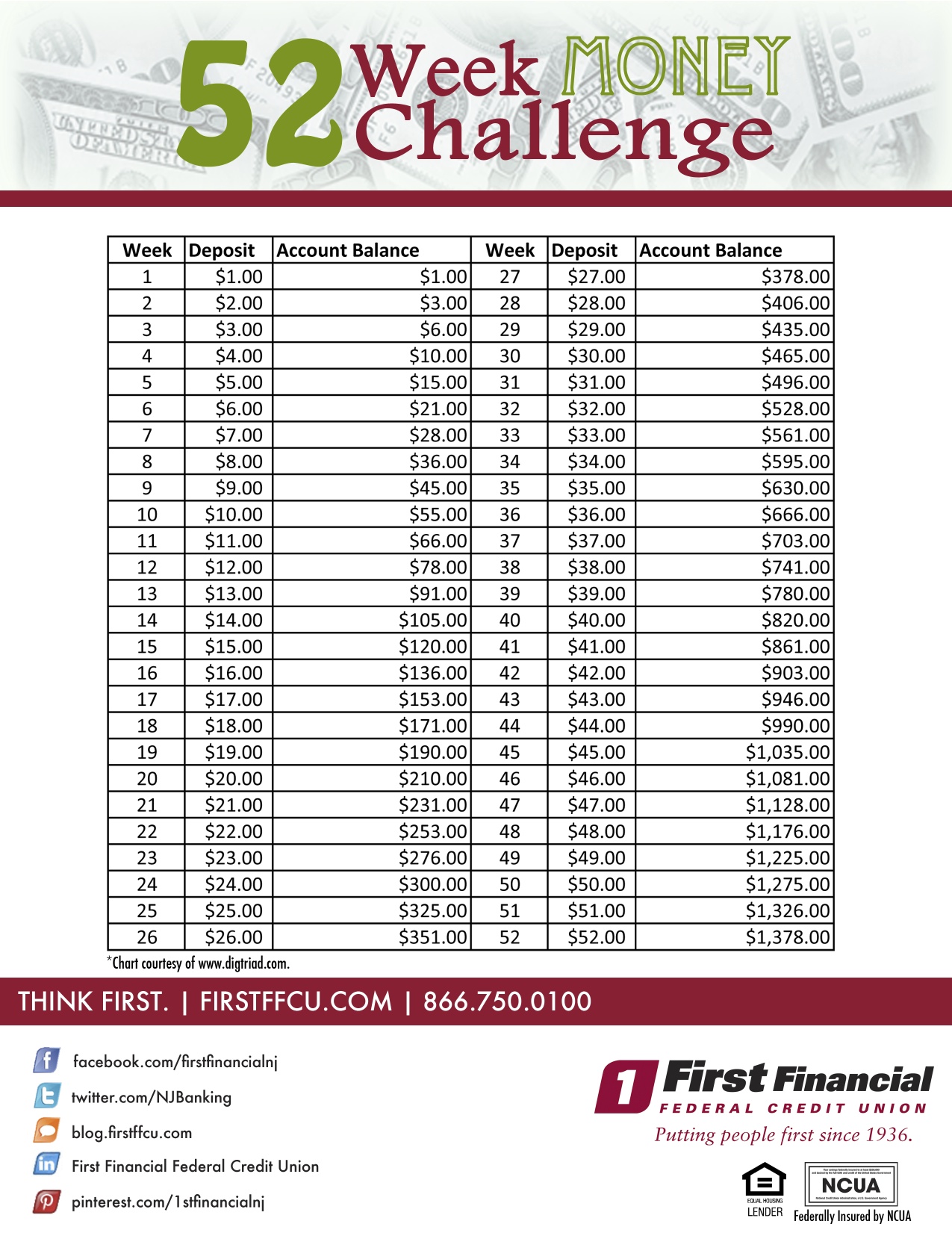
52 Week Savings Challenge

Start your new year off the right way – by saving money.  Take the 52 week money challenge below, and you’re guaranteed to save almost $1,400 by the start of the new year. Ready, set, go!

52WeekMoneyChallenge JPEG

Back to School Shopping Strategies to Spend Smart

back-to-schoolSo here is the deal: it is impossible to avoid back to school shopping. The plain truth is you need to get certain supplies to make sure your child is prepared for back to school season. This can become quite expensive, as children seem to need more and more every year. But savvy spenders know that there are several tips and tricks you can follow in order to save big. You don’t have to be a shopping guru or expert in order to save, you just need to know where the deals are, and the places you can save a few pennies. Below, you will find back to school shopping strategies to spend smart and save big.

You will find that these tips are simple to follow and don’t require a great deal of know how or time. Give these tips a try and see how easy it is to shop smart and save big. Take a peek!

1. Get your child involved.

Explain to your child what the difference between wants and needs are. They won’t be able to get every single item they want and you should be able to tell them that. Before shopping, make a list with your child based on the list the school provides. Make sure your child understands what they will be getting to prepare them for school and what can wait.

2. Eliminate gimmicks.

Teachers will tell you that things like sparkly erasers, light up pencils, and other fancy items can be a distraction. They are not only a distraction, but they are more expensive than plain items. Instead, forget about these back to school gimmicks and keep things simple. It costs less.

3. Keep your supply list in the car.

While you are running your errands, you will want to keep your list on you should you run into any deals. If you don’t have your list, you could miss out on a hot deal. Keep your list in your car or in your purse so if you come across a sale or a free with rebate deal, you have your list to see if you need it or not.

4. Buy basic supplies in bulk.

You can buy basic supplies such as paper, pencils, and notebooks in bulk. Warehouse stores are perfect for buying these items for less and having enough to sustain you for the rest of the year. Do the math and make sure the bulk price beats the a la carte price before you shop.

5. Negotiate a group discount.

Gather the other parents at school and see if you can rally together to save. A group of parents may be able to negotiate a group discount from a local office supply store. Contact stores in your area and see if they are open to the possibility of this. Then, contact parents and get the ball rolling.

6. Stock up and set up a home store.

Buy items on sale, free with rebate, or in bulk and then gather them in a storage bin. Keep the bin in a safe place where they can be shopped during the year as they are needed. That way, you are not having to run out and buy items during the year, possibly spending more.

7. Help your school and yourself.

Ask if your school participates in a program like OneCause. If so you can shop for supplies often receiving a discount and special coupons. Plus with your purchase, your local retailer will donate a percentage to the school of your choice. It is a win/win!

See how easy it is to save money on back to school? With these back to school shopping strategies you can learn how to spend smart and save big. These tips will help you make the most of your cash and stretch your shopping dollar. Give them a try and see how quickly the savings add up for you!

*Click here to view the article source.

7 Tips for Saving Time & Money When Shopping Online

Ever wonder what the real experts know that you don’t when it comes to online shopping?

Little tricks of the trade that make the buys better, the discounts deeper and the whole experience of online shopping even smoother?

It comes down to a few smart strategies, a little organization — and the willingness to walk away from sites that skimp on consumer must-haves, like convenience and security. These days, when it comes to retail goods, shoppers are making more than one out of every six purchases online, according to statistics from the National Retail Federation. And that number is growing. Want to make your surfing, clicking and buying quicker, cheaper and easier? Here are seven insider strategies:

1. Get the coupons, skip the spam.

What’s the difference between getting a big discount and missing out entirely?

With online shopping it can be a matter of timing. Most online shops “release coupons on the second of the month or on the 27th or 28th,” says Hillary Mendelsohn, author of “the purplebook” online shopping series.

“So that’s good to know, timing-wise,” she says. While coupon codes are great, stores don’t always release them to coupon code aggregating sites, Mendelsohn says.

Her strategy: She registered for a free email account and uses that address to sign up for coupons at the stores she regularly shops. When she’s ready to buy, Mendelsohn logs into the email account and does a quick search for that store. What she has instantly: All its coupons.

“This is a great way of not having your [regular] email box filled with spam and being able to access the deals you want all the time,” Mendelsohn says.

2. Consider automating regular buys.

Have something bulky or heavy that you buy regularly?

Instead of lugging it home yourself, consider setting up an automated order, says Mendelsohn, who uses Amazon’s “subscribe” feature to get her kids’ favorite tea by the case every other month.

“I don’t have to place the order, and I get a discount,” she says. “And it’s free shipping. It makes a huge difference, and I don’t have the schlep it.” What it’s good for: “Big things you need constantly” from diapers to dog food, she says. “You save money, you save time and you save schlep energy.”

Free shipping can also sub in for “free delivery” for large one-time purchases, such as patio furniture and ping-pong tables, she says. With all the options for shopping and delivery, it pays to think strategically and “be smart about what you order online and what you go to the store for,” Mendelsohn says.

3. Coupons + discount gift cards = more savings.

What’s better than a coupon for something you need? Being able to combine that coupon with a discounted gift card to amp up your savings.

And while you often can’t use two different coupons on one item, you can use a coupon with a gift card purchased for less than face value, says Michelle Madhok, founder of SheFinds.com, an online shopping site.

Madhok’s tip: Use a gift card search site (her favorite: GiftCardGranny.com) to find a reputable seller for whatever card you need. And stick with well-known, legit companies, rather than individuals, she advises.

You can often buy them for 6% to 15% off face value and many are ecards, so you don’t have to wait for delivery, Madhok says. Then “stack the deal” with a coupon or promo code, Madhok says. Recently, “I used a digital gift card and coupon code on a $300 purchase and ended up saving about $50,” she says. Want to ratchet that up even more? Use a credit card that gives you rewards or cash back, says Madhok. Some cards will even boost those rewards if you buy from certain merchants or use the card’s app or online site as a jumping off point for your shopping.

4. Use alerts to save, not spend.

Be careful about subscribing to those “daily deals,” says Kit Yarrow, consumer psychologist and author of “Generation BuY: How Tweens, Teens, and Twenty-Somethings Are Revolutionizing Retail.”

Here’s why: They present a sudden deadline, plus an element of competition, she says. “People make hasty decisions when they feel like they’re competing with other shoppers.”

“I’ve found that shoppers tend to end up buying more, and they also buy less-satisfying things through this process,” Yarrow says.

When alerts can save: After you buy. Set up a price alert for the item and if the price drops, email customer service about a refund of the discounted amount, says Madhok, who used this recently to save $70 total on two separate buys. “Usually, they’ll honor it within two weeks” of purchase she says.

5. Make the most of that shopping cart.

If you want to save a few bucks, that shopping cart is valuable real estate.

“Pre-load your shopping cart with items you’re hoping to buy, in order to snap them up quickly if they go on sale,” says Yarrow.

“Most sites don’t empty your shopping cart if you’re a registered user,” she says. “So when they go on sale, you’re ready to go.”

It gives you time to rethink your buying decision, too, she says. “This process also helps shoppers make better decisions because it forces a ‘cooling off period.'” Want an extra incentive not to spend? Consider the cost and hassle of returning before you click “buy,” says Yarrow. And find out who pays return shipping.

6. Find out upfront: Available or back-order?

Shopping under a deadline? Check back-order before you pay, says Leslie Linevsky, co-founder of Catalogs.com.

Ideally, sites should notify you that something is out of stock when you place it in your shopping cart, she says. But not all of them do. Some notify you after you’ve given your card information, but before they bill you, Linevsky says. Others may not tell you at all. So keep back-order in mind as you shop and look for indicators that your merchandise is actually available. If the site doesn’t disclose if an item is in stock, call before you place the order, says Linevsky. Or go to a site that makes it plain, she says.

7. Practice safe shopping.

If you really want to save time and money, it pays to be as safety conscious online as you would be at your neighborhood mall.

Some smart habits:

  • When you’re supplying personal data (such as your name, address or card number), make sure you’re on a secure, encrypted page, says Frank DeBlasi, co-founder of HooplaDoopla.com, a cash-back shopping site.
  • If the URL has an “s” (for “secure”) after the “http,” that means “any information you send is being transmitted securely,” he says. “You never want to shop anywhere that doesn’t have that.”
  • Likewise, you don’t want to use public or office computers for shopping. Information can linger, even if you think you’ve erased it. (Not to mention that some employers actually monitor your keystrokes.)
  • Skip the public WiFi, too, says DeBlasi. “You never know the true level of security of the network you are connected to,” he says. “On your home network, you have control of the level of security.”
  • And watch how you pay. “Always use a credit card when you purchase online, not a debit card,” DeBlasi says. With a debit card, if something goes wrong, you’re fighting to get back cash that’s already missing from your account, he says. “When you use a credit card, you have a middle man in the transaction. And the money isn’t removed from your account.”

Article Source: Foxbusiness.com

new%20ncua%20disclaimer-resized-600equal%20housing%20lender%20logo-resized-600