
How to Save Money Without Disrupting Your Lifestyle

Blog-Crop

What if you could save an additional $1,500 each year? After 30 years you would have $119,000, assuming the money was invested and you got a 6% return. That $1,500 each year — just $125 a month — can add up to quite a bit of money.

Of course, to save more money each month you likely need to cut your spending. But if you are like most people, you probably don’t want to drastically change your lifestyle. Fortunately, there are smart and simple steps you can take to trim spending without a major overhaul.

Use the 72-hour rule for purchases

How many purchases have you made on Amazon or at the store that you later regretted? Limit your impulse purchases using what personal financial author Carl Richards has called the 72-hour rule. Instead of buying an item you want immediately, wait 72 hours to see whether you still want it. You’ll be surprised at how much less you end up deciding to buy. It works great with kids – they think they can’t live without a certain toy, and then after 72 hours they forget it even existed.

Analyze big purchases

Major purchases may have the biggest impact on your spending and ability to save. It’s sometime bewildering that the same person who will drive across town to save money on gas will buy a new expensive car without analyzing the implications. The same goes for housing costs or big-ticket vacations. Here are some tips on how to analyze and save on each of these purchases:

  • Car: The Internet has been a huge help for consumers in finding car deals. With online sales you often can negotiate through email, and sites like TrueCar provide transparency about what other car buyers have paid. But when buying a new car, it’s important to consider the ongoing costs and not just the upfront purchase price. For instance, many people prefer luxury cars, but premium gas and maintenance typically will cost more for these cars. Finally, a simple rule is that the longer you keep the car, the cheaper the cost.
  • House: Housing tends to be the biggest expense for most people. If you plan to live in the same place for five years or more, it’s recommended you purchase a home. However, the larger and more expensive the home you purchase, the more it limits your ability to spend within the rest of your budget. For example, a couple with one child, decides to downsize because they just didn’t need the space. This was a good move financially because it gives them greater flexibility to save more, spend in other areas or retire sooner.
  • Vacation: Research locations and potential deals on sites like Kayak.com. If you can, be flexible when selecting travel dates to maximize savings. Also, compare multiple locations to determine the best fit for you and your family — and where you can get the most bang for your buck.

Rethink ongoing phone and cable plans

Most people look only at their monthly payments and often are shocked by how much they spend annually on cell phone and cable bills. When shopping for a phone plan, try MyRatePlan.com to compare plans based on the minutes, texts and data you need. Another option is to consider no-contract cell phones. The monthly cost is much lower, but you do have to buy the cell phone upfront.

With cable, the average monthly bill is $100, or $1,200 a year. “Cutting the cord” has become more popular recently as many people decide they don’t need the 100+ channels on cable. If you can do with a limited number of channels, then a streaming device and a good HDTV antenna for local channels may be all you need — and it can save you a lot of money.

Review your insurance policies

Many people are paying too much for property and casualty insurance. Every few years you should shop around your auto insurance and home insurance policies to confirm you are getting a good price. You also can see how your auto and home insurance providers rank based on consumer satisfaction by checking out the yearly report from market research firm J.D. Power.

Additionally, one way to lower premiums for home or auto policies is to raise your deductible if you have cash in the bank and you rarely make any claims. Larger deductibles typically range from $1,000 to $2,500, depending on the type of insurance you have. However, note that this does create risks if you don’t have money available or in an emergency fund if a large claim does occur.

Pick high-quality products that last

Sometimes it makes sense to spend a little more money for items you will use for a long time. A good example is men’s shoes. A high-quality pair of shoes will last almost forever and, though more expensive in the short term, will be a lot cheaper over the long run than repeatedly buying the cheapest pair. Think about the items in your life that you will use for a very long time and are worth the extra expense upfront.

Stick to a budget

First, automate your savings. It’s hard to spend what you don’t see, so automatically transferring money out of your checking account will help you keep spending down. Determine how much you should be contributing to or withdrawing from your accounts, and set up automatic monthly transfers. I like to call this forced scarcity, in that you can spend only what is in your bank account.

If this is not working and you start running up debt, try using online budgeting tools to help you create and monitor your budget. It may be more time-consuming, but you’ll know where every dollar is being spent. And if you are still having issues, consider working with a fee-only financial planner to help you develop and stick to a budget so you can reach your goals.

Hire a professional

Sometimes spending money can save you money. This can be true for home repairs, taxes, college planning and many other areas. For instance, many people miss important deductions or credits they could have claimed when they complete their own tax returns instead of working with a professional. Sometimes it makes sense to pay someone to help when it comes to house repairs and you can try to fix the problem, but might only make it worse.

So how do you decide whether to hire a professional or go it alone? If the risk of mistake is greater than the cost to hire someone, it is worth the investment. Of course, if you don’t have the time or knowledge to take care of the task at hand, it makes sense to get help, too. If you’re not sure where to look, ask for referrals from friends or co-workers, or check Angie’s List for service providers and the National Association of Personal Financial Advisors for fee-only financial planners.

Spend wisely

Ultimately, the goal is not to disrupt your lifestyle dramatically, but to make sure you spend your money wisely and efficiently. In short, it’s important to think about what you are spending your money on and what you really get out of it.

Perhaps even more important than drastically cutting your spending is thinking about the non-monetary value of your money. In a longitudinal study following 268 men for over 70 years, researchers for the Grant Study found that good relationships are key to leading a long and happy life — not how much money you have, the newest tech gadget or a certain high-profile job, but the people in your life.

Instead of spending money on more stuff, why not spend it on personal experiences with your friends and family?

*Original article source courtesy of Mike Eklund of Nerd Wallet.

8 Money Saving Hacks For Your Home

We can probably all agree that saving money is never a bad thing — and it’s even better when we don’t even have to deprive ourselves of things we enjoy, like ordering in, chai lattes, or HBO. It’s why simple ways to save money around the house are generally so awesome; they’re often small or one-time changes that pad our wallets yet take minimal effort or self-restraint.

There are so many money-saving tips that are relatively simple and achievable if you put your mind to it and almost all require a little change in routine, like packing lunches for work the night before, or consciously not buying coffee outside of the house. For the most part, they consisted of common-sense advice that you may have already considered doing yourself at one point or another (how many times have you bought that afternoon four dollar latte and already kind of known you shouldn’t).

It’s the little hidden things around the house that we often don’t even think of at all that make up the easiest ways to save money here and there, and it’s because of this that I’ve compiled eight incredibly easy and near effortless tips that will save money.

1. Unplug You Electronics At Night.

For real guys. According to Time Magazine just simply unplugging things like your laptop and TV at night can save about $100 a year. That’s 100 bucks you can spend on a massage (or, better yet, actually save…). And if this seems like a pain, just connect your devices to a single power strip and turn them all off with the click of a button each night.

2. Update Your Lightbulbs.

According to a piece in SFGate, the overall cost of an energy-efficient light bulb is $28 over it’s lifetime, whereas a regular light bulb will cost you around $120 a year in energy bills. You’re thus saving about $92 with every energy-saving bulb you purchase, and because they actually last longer, you’ll be buying them less often.

3. Don’t Buy Bottled Water.

A piece for Today about our dubious addiction to bottled water pointed out the fact that 90 percent of tap water meets regulations set up by the EPA, whereas bottled water does not technically have to meet any EPA standards, and it costs around $2 a bottle. And while the piece points out that we don’t technically need home filtering devices for safety since most tap water is actually perfectly save to drink, they’re still way cheaper than a bottle-a-day habit. So buy yourself a Nalgene or Brita and count the dollars saved!

4. Use Blinds to Reduce the Need for AC.

The piece in Time also noted that reflective blinds can reduce heat gain in summer by about 45 percent, and that means you can go that much longer without using your AC. In New York City, where electric bills are hiked up in summer specifically because the electric company anticipates more air conditioner usage, this make a huge difference. So keep those blinds down during the day while you’re at work for a much cooler home temperature when you return in the evening.

5. Clean You Dryer’s Lint Trap.

According to Melissa Maker, cleaning expert and founder of CleanYourSpace.com in an article for Today.com, just removing lint from the trap after every few loads isn’t enough. Instead you should give it a thorough cleaning every six months in order to extend your dryer’s shelf life. “Just use warm soapy water and a cleaning toothbrush, wash gently, and leave to dry overnight. Your dryer will work much more efficiently,” she said, adding, “Vacuuming the dryer lint trap is also important to remove any lodged dust, which can be a fire hazard.”

6. Cook With The Right Size Pans.

This tip from Energy.gov was totally news to me when I first read about it; apparently cooking with a pan larger than you actually need makes cooking time take longer, as larger pans absorb more heat, which means you’re spending more money on energy overall. So be sure to use the proper pan size whenever possible for a super easy money-saving hack.

7. Use Your Slow Cooker When You Can.

The same piece for Energy.gov pointed out that using a slow cooker to cook things that take several hours, like stews and chilli, burns way less energy than when cooked on the stove. This means you’ll also be paying less money on gas or electric at the end of the month.

8. Keep a Coin Jar.

This final personal tip isn’t so much about saving money as it is about keeping track of the money you never even notice you have — coins! Some people keep a coin jar in their bedroom for all of their loose change. You’ll be amazed at how much you can save up within a year – so grab a grubby cup and fill it with that pocket change!

Saving money isn’t always the most fun thing on the planet, and — let’s be real — sometimes it can actively be a bummer. The good news is there are a few super simple ways to save a few extra hundred dollars a year that won’t actually feel like you’re doing anything at all.

*Original article source courtesy of Toria Sheffield of Bustle.

How to Save Money on Big Expenses

bigstock-Chinese-family-saving-money-fo-85083275We’ve finished the first quarter of the year and for many of us, our new years resolutions are now just a distant memory. According to data from StatisticBrain.com, 29 percent of resolutions don’t make it past the first 2 weeks. In order to help those still hanging in there with one of the most common resolutions — spending less, and saving more — we take a look at some of the things burning the biggest holes in American pockets and how to deal with them.

Save on Airfare.

A recent study by ValuePenguin.com found that Americans collectively stand to save $200 million their airfare expenditures by utilizing reward credit cards. By examining data from the Bureau of Labor Statistics, the research found that approximately 10 percent of all U.S. households reported airfare spending throughout the year, and a whopping 90 percent had gasoline expenses. While the price of oil has dropped in recent years, airfare prices are still burdened by heavy taxes and fees — making them as expensive as ever.

One of the easiest ways to save on airfare is to take advantage of loyalty miles/points and reward credit cards. You don’t have to be a travel hacker to qualify for savings on airfare and hotel stays. Most credit cards can get you 1 percent back on your expenditures, in the very minimum. In the long-haul this can add up to significant savings.

All you have to do is remember to actually use the reward points you earn. A few years ago, a joint study between Colloquy and Swift Exchange showed that $16 billion worth of loyalty program rewards go unredeemed each year. With how much banks have been upping bonuses and rewards since that study was published, that number is sure to be much higher now.

Save on Housing.

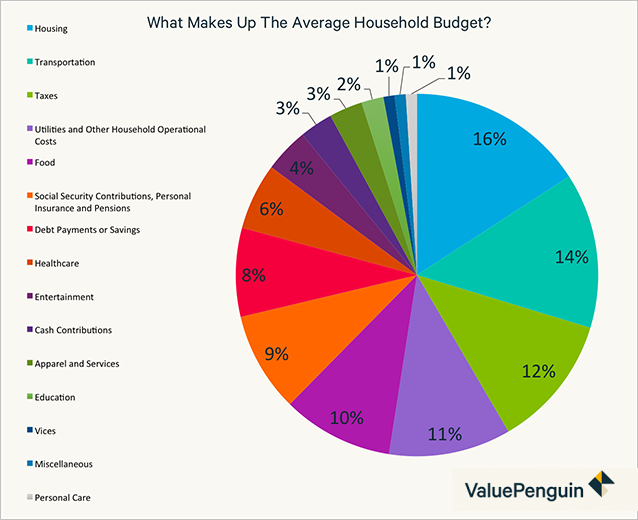
Housing expenses make up the largest portion of the average household budget— a little over $10,000 is spent annually. Finding ways to reduce these costs can be tricky, and advice will usually vary depending on weather you own or rent your dwelling.

2016-01-11-1452523146-9486929-averagehouseholdbudget.png

The biggest way you can save, in both cases, is by taking on a roommate. While inconvenient, it is the fastest way to reduce your total costs down by as much as 50 percent. If you have a spare bedroom that isn’t being used, taking on a house guest should be an option to consider.

Estimates state that nearly two-thirds of Americans have a mortgage — which can be bad news given the fact that the Fed has recently upped interest rates. In order to prepare themselves for increasing housing costs, homeowners should take a moment to familiarize themselves with their loan. If you have a variable interest rate, it may be a good time to lock into a fixed rate. However, you need to offset that with the new closing costs. Consider contacting a financial planner or consultant to determine the best cost-saving option for you.

Save on Entertainment and More Along the Way.

While the average U.S. household spends just 5.4 percent of their annual budget on entertainment, it’s a category worth mentioning due to the sheer reach it can have. If you plan accordingly, and pick up the right hobby, you can save yourself a lot of money on being entertained, while at the same time save a ton of money.

One of the best hobbies you can pick up for your wallet is cooking. Eating out, especially if you live in a big city, can be a massive drain on your wallet. While you eat that plate of fancy Italian pasta, it’s taking bigger bites out of your finances. While you may not end up as the next-iron chef, challenging yourself with new recipes can be a good way to get through a boring day.

Exercise can be another way to entertain yourself, fulfill another resolution, and it doesn’t require a gym membership. You’re one quick Google search away from finding thousands of free exercises you can do from home, with no equipment requirements. Plus, if you combine this with the above cooking suggestion — your new healthier lifestyle can help partially reduce down another major expense, healthcare.

*Original article source courtesy of Robert Harrow of the Huffington Post.

Money Saving Tips for the Week

bigstock-Money-8204584We often associate certain days of the week with particular activities. For example, Monday is generally considered the start of the work week. Perhaps Wednesday is the night your favorite show airs on TV, while Friday — well, thank goodness it’s Friday.

When it comes to our personal finances, we should consider following the same trend of associating days with various activities. Each day of the week offers an opportunity to save money or improve our finances. They key is to be aware of how to save money by knowing what steps to take on which day.

Here are some tips to save money each day of the week.

Monday: Set the Tone for the Week.

On Monday, you can set the tone for the week, helping to determine if you stick to your spending plan for the remaining days, said Tom Corley, author of the bestselling book, “Rich Habits: The Daily Success Habits of Wealthy Individuals.” For example, if you promised yourself that you would drink coffee from home and pack lunches to save money, you need to make it a habit starting on the first day of the week.

“The way to turn this into a habit is to make your five brown bag lunches the night before,” Corley said. “Those brown bags will then act as a trigger, reminding you to make your own coffee.”

You could even take it a step further and make Monday a no-spending day to start your week off on the right financial foot. Mark the day on your calendar and set up an alert, so you’ll get an email or message on your smartphone every Monday reminding you not to spend any money that day.

Tuesday: Get a Deal on a Flight.

If you need to book a flight, it’s wise to do so on a Tuesday, when U.S. airlines typically release flight sales, said Jeff Klee, founder and CEO of CheapAir.com. Browse fares early to mid-Tuesday to find the best deals.

“The caveat is that there are limited seats available at the sale price, so you have to be super quick to book when a sale is launched,” he said, adding that Tuesdays and Wednesdays are also the cheapest days to fly. Because fewer people travel mid-week, it’s smart to arrange your plans so you leave and return early in the week as opposed to on weekends.

Tuesday is also a good day to get deals on dining and entertainment because establishments tend to do less business then. As a result, many restaurants — including T.G.I Friday’s, Chick-fil-A and Denny’s — host kids-eat-free days on Tuesdays, said Howard Schaffer, vice president of deal site Offers.com.

Additionally, many movie theaters offer discounted tickets and concessions on Tuesdays, said CouponSherpa.com shopping expert Kendal Perez. For example, Perez said she pays $5.50 per ticket on discount days versus the regular matinee price of $7.50 or evening price of $9.25. To get discounts on concessions, consider joining your favorite theater’s rewards club.

Wednesday: Save Money on Groceries.

Saturday is the busiest grocery shopping day of the week, according to an article from The Street. However, it’s not the best day to go to the market if you want to save money.

“To save money on groceries, shop on a Wednesday,” said Kyle Taylor, founder of personal finance blog ThePennyHoarder.com. “That’s when most stores release their weekly discounts, but they’re also likely to honor the previous week’s coupons [on this day].”

Check your supermarket’s local sales ad, which you can generally find online or at the store’s entrance. In many cases, you can locate “buy one, get one free” deals or discounts of up to 50 percent, said Taylor. To maximize savings, craft your menu and shopping list for the coming week based on what’s on sale.

Friday: Build Your Savings.

If you typically get paid on Friday, then it’s a good day to boost your savings. Rather than give in to the temptation to indulge yourself by spending your entire paycheck, Corley recommends having a percentage of your pay automatically deposited into a separate savings account — ideally one without a debit card linked to it. Doing this forces you to live below your means because you won’t have easy access to those additional funds.

“It is hard at first to pay yourself first this way, but over time it gets easier,” Corley said.

In his new book, “Change Your Habits, Change Your Life,” the author writes that individuals should set a goal of saving up to 20 percent of their income. For best results, allocate your savings among four buckets — with half going to a retirement savings account, 20 percent for major future expenses, 15 percent for unexpected expenses and 15 percent for cyclical expenses, such as holidays and birthdays.

Saturday: Get Deals on Apparel.

Wait until the weekend to buy clothing, as that’s when you can typically get the deepest discounts. Retailers such as Kohl’s and Macy’s often have sales on Saturdays that feature better markdowns than customers would find during the week, said FatWallet.com‘s online shopping expert Brent Shelton.

Additionally, consumers can score extra discounts by using their mobile devices, he said. Download retailers’ apps to get exclusive deals and take advantage of all the best ways to save money.

Finally, weekend shoppers can take advantage of coupon codes, which are released from apparel merchants in the highest volume on Fridays, said Slickdeals.net shopping pro Regina Conway. “In some cases, you can apply the code on top of weekend sale pricing to save even more,” she said.

Sunday: Review Your Spending.

“Although Sunday is usually a day to relax, it’s also the perfect time to make sure you’re on track with your weekly and monthly spending plan,” said Holly Johnson, a credit expert and creator of ClubThrifty.com.

Johnson and her husband sit down every Sunday to review their budget and see how much they’ve spent in each category — such as food, gas and entertainment — and how much they have left for the remainder of the month. “This helps us ‘reset’ our spending and make sure we’re on track with our monthly spending goals,” she said.

On Sunday, the Johnsons also pay off their credit cards, which they use for all of their regular purchases to create a paper trail and maximize credit card rewards. Even if you don’t pay off your credit card balance each week, it’s a good idea to check your account regularly to ensure there aren’t any unnecessary fees or unrecognizable charges that could be the result of fraud.

Reconcile your spending on Sunday to start the week off on the right financing footing come Monday!

*Original article source by Cameron Huddleston of GoBankingRates.com.

4 Ways You Can Trick Yourself Into Becoming a Better Saver

bigstock-Closeup-of-hundred-dollar-bill-26175143For many people, the biggest hurdle to saving is creating the habit. While many financial advisers often recommend that clients take the work out of the process by having savings automatically deducted from each paycheck, plenty of people still struggle to get started. “We’re not seeing progress on the savings front,” said Greg McBride, chief financial analyst for Bankrate.com, which found in a survey that 22 percent of consumers have more debt than emergency savings. “And it’s desperately needed.” Without savings, he adds, some consumers may pile on more debt when emergencies happen.


Some people need a bigger incentive, say the pressure of knowing someone else is counting on you or the chance to win money, to finally kick-start the habit. During America Saves Week, a campaign organized by nonprofit, government and private groups to encourage financial literacy, rounded up some creative ways to boost your savings. Here’s what they came up with…

1. Get your friends involved. If you struggle to have the self-discipline to save on your own, it might help to have some friends hold you accountable. Through so-called lending clubs, a group of people get together to pool their savings, giving the cash post to a different person each week. For example, say 10 people contribute $100 each for a total of $1,000. Over the course of 10 weeks, the cash pot goes to a different person each week until everyone has had a turn. For those early in the cycle, it can be like receiving a short-term loan, said Jonathan Morduch, economics professor at New York University’s Wagner school. For those who receive the cash toward the end of the cycle, it can feel like a forced savings program, he added.

In some cases, the pressure of knowing that other people are counting on you can be more effective than setting aside $100 a week into a savings account, said Morduch, who studied the approach as lead researcher for the U.S. Financial Diaries, a project that followed the weekly cash flow of 235 families for a year. “It’s different from the way we usually think about savings, as slow and steady,” he said. “This is something that works for a lot of folks.”

2. Make it a competition. Savings contests, such as the 52-week savings challenge, can make saving seem more approachable by breaking a larger goal down into small weekly sums. While it’s usually a system that’s talked about at the start of the year, the approach can work for any year-long period. Basically, consumers start small, saving $1 the first week, $2 the second week, and so on all the way to $52 for the last week. At the end of the challenge, the account should have $1,378. Starting the challenge with friends who remind one another to make contributions each week can help some people find the motivation to keep saving, even as the amounts grow.

3. Save your change. You can do this the old-fashioned way, where you throw the singles and coins left in your bag at the end of the day into a jar, McBride said. At the end of the week or month, you can take the cash and deposit it in a savings account, he said. But if you’re like the many people more prone to using plastic than cash these days, you might want to check whether your bank offers a way for you to do this digitally.

4. Have an app do it for you. New smartphone apps are making it easier for people to save by automating the process. One app, Acorns, makes it possible for people to set aside their spare change from everyday purchases. But instead of going into a low-interest savings account, the money is stored in a portfolio that invests in exchange-traded funds. Savers need to pay $1 a month in management fees for accounts smaller than $5,000 and a fee that adds up to 0.25 percent of assets for accounts $5,000 or larger. Another app, Digit, studies users’ cash flow and makes automatic transfers to a savings account two or three times a week. The program, which doesn’t charge fees, analyzes when a person is paid, what bills he has to pay and how he generally spends. Then it moves cash that could be extra, typically ranging from $5 to $50, into a separate account. “You don’t actually feel the money missing,” said Ethan Bloch, chief executive of Digit.

*Original article source courtesy of Jonnelle Marte of The Chicago Tribune.

13 Things You Should Accomplish with Your Money Before Turning 30

15243065209_00ddfac88c_k

When it comes to managing money, time is on your side in your 20s. A head start on saving and investing could mean huge financial gains in the future. To help you optimize this decade, we’ve come up with 13 milestones to aim to achieve before hitting 30:

  1. Build an emergency fund. Life is full of unexpected — and, often, costly — surprises. That’s why it’s crucial to build an emergency fund.The amount of savings you need is highly personal, but a general rule is that it’s smart to have three to nine months’ worth of living expenses tucked away. Of course, you may need more or less depending on your situation. By 30, you should be at, or well on your way to, that three- to nine-month mark.
  2. Negotiate your salary. You can’t sit around and expect a raise or bonus to fall into your lap. Even if your boss notices your hard work and efficiency, he or she won’t necessarily pay you more. You have to ask for what you want.As personal-finance expert Farnoosh Torabi, who doubled her salary at 26, preaches, “You don’t get what you deserve. You get what you negotiate.”There’s a right and a wrong way to go about this delicate conversation. Read up on things you should never say in a salary negotiation, and know what you’re worth before heading into the meeting.
  3. Contribute at least 10% of your income to a retirement account. Retirement is never too far off to neglect, especially since time is on your side when you’re young. In fact, when you start to save outweighs how much you save, meaning your 20s are a critical decade.Many experts recommend putting aside at least 10% of your income. That may not be possible when you’re first starting out your career, but it’s a good goal to have by 30.Get in the habit of upping your contribution on a consistent basis — either every six months, at the end of each year, or whenever you get a pay raise — and work your way up to a 10% contribution or more.Set up a no-cost, no-obligation appointment with our Investment & Retirement Center at 732.312.1500, mary.laferriere@lpl.com or maureen.mcgreevy@lpl.com, or stop in to see us to discuss your future savings goals.*
  4. Establish savings goals and start setting aside money for big purchases. There are bound to be big expenses in your future — a home, car, vacation, and kids, to name a few — that require diligent saving.The best way to prepare for these expenses is to create savings goals, and then set aside money as early as possible. You’ll want to adjust your budget so you can contribute a specific amount of money — depending on your upcoming purchases and time horizon — into a savings account each month. Treat this money like a fixed cost, meaning you must set it aside like you would do for rent or utilities.Pro tip: Set up automatic transfers from your checking account to your savings accounts so you never even see this money and learn to live without it.
  5. Establish wealth goals. In addition to savings goals, you’ll want to establish goals for your annual income and net worth. Money won’t just appear — you have to work at it. If you want to eventually build wealth, you have to have a clear and specific goal in place before forming a financial plan to achieve that goal.Be realistic when setting a time frame to attain these bigger wealth goals, but at the same time, think big and don’t be afraid to challenge yourself. A distinguishing characteristic of rich people is their commitment to setting high expectations.
  6. Buy the insurance you need. Nobody wants to deal with insurance — it’s complex and confusing — but by 30, you should have the coverage that’s right for you. That means health, renter’s (or homeowner’s if you have your own place), auto, and disability insurance. And depending on your situation, it may mean life or pet insurance.It’s also smart to make a habit out of reevaluating your insurance plans each year to ensure that your coverage is still working for your needs and budget.
  7. Set up a method to start tracking your expenses. By 30, you should have a very good idea of how much money is coming in and how much is going out.Apart from making sure you’re earning more than you’re spending, you’ll want to get a good idea of whether or not you’re on track with your savings and retirement goals. You’ll also want to see if there’s any room to reduce spending and up your saving.Strategies to track cash flow include recording each purchase you make in a spreadsheet or notebook, or downloading an app that will categorize and monitor your monthly and annual spending, such as Mint.
  8. Pay off some of your student debt. Student-loan debt in particular is often blamed for preventing young people from buying homes and growing their wealth, so the sooner you can start living debt-free, the better.Plus, the longer you wait to pay it down, the more you’ll owe, thanks to interest. Interest works in your favor with your savings and to your detriment with your debt, when it can build up over time and sometimes end up costing more than what you originally borrowed.
  9. Experiment with a side hustle. It’s easy to focus on cutting costs and forget about earning, but the wealthiest, most successful people develop multiple streams of income.Earning more money is often easier said than done, but most people have options. Plus, it’s good to experiment with being your own boss, rather than working for your money. After all, there is a significant difference between how rich people and average people choose to get paid.
  10. Invest in something other than your retirement savings plan. Many experts recommend using investment vehicles in addition to your employer’s retirement plan to ensure that you’ll have enough to fund your golden years.If you’re maxing out your 401(k) plan, consider contributing money toward a Roth IRA or traditional IRA, research low-cost index funds — which Warren Buffett recommends — and look into the online-investment platforms known as “robo-advisers.”Of course, you’ll want to make sure that your general finances are in order before you invest. But if you have a sound emergency fund, have prepared for future expenses, and are debt-free, then the quicker you put your money to work and jump start its growth, the better.
  11. Establish a strong credit score. Your credit score, which you can check as often as you want through free sites like Credit KarmaCredit.com, or Credit Sesame, is a three-digit number between 301 and 850 based on how you’ve used credit in the past.Generally, you don’t want your credit score to dip below 650, as potential creditors in the future will consider you less trustworthy and less deserving of the best rates.While often overlooked or forgotten about, building good credit early on is essential. It will allow you to make big purchases in the future, such as insurance, a car, or a home. Start by selecting a good credit card and then focus on establishing smart credit card habits.
  12. Make your payments automatic. In today’s technologically savvy world, there’s no excuse to ever miss a payment. Most bills can be paid online, and you often have the option of setting up automatic payments. If you automate consistent payments for fixed costs — cable, internet, Netflix, and insurance — you won’t have to think about them every month and will never miss a bill.You can do the same for variable costs such as credit-card bills, although you’ll want to check in on your account regularly to make sure that things are going smoothly and there aren’t any signs of fraud.For payments that can’t be made online, such as rent, set up calendar reminders and get in the habit of paying them around the same time each month so it becomes routine.
  13. Invest in yourself. The wealthiest, most successful people are constantly exercising their brains and looking for ways to continue learning long after college or any formal education is over.Self-educate by enrolling in a course, attending a work-related conference, or investing in books. On a similar note, invest in your health — consider pursuing an appealing form of exercise, or anything else that will better your health and strengthen your mind.As self-made millionaire Daniel Ally, who reached millionaire status by 24, emphasizes: “You must take your education into your own hands if you want to prosper. Invest in yourself.”

*Securities and advisory services are offered through LPL Financial (LPL), a registered investment advisor and broker/dealer (member FINRA/SIPC). Insurance products are offered through LPL or its licensed affiliates. First Financial Federal Credit Union (FFFCU) and First Financial Investment & Retirement Center are not registered as a broker/dealer or investment advisor. Registered representatives of LPL offer products and services using First Financial Investment & Retirement Center, and may also be employees of FFFCU. These products and services are being offered through LPL or its affiliates, which are separate entities from and not affiliates of FFFCU or First Financial Investment & Retirement Center.

Securities and insurance offered through LPL or its affiliates are:

Original article source courtesy of Kathleen Elkins of Business Insider.